
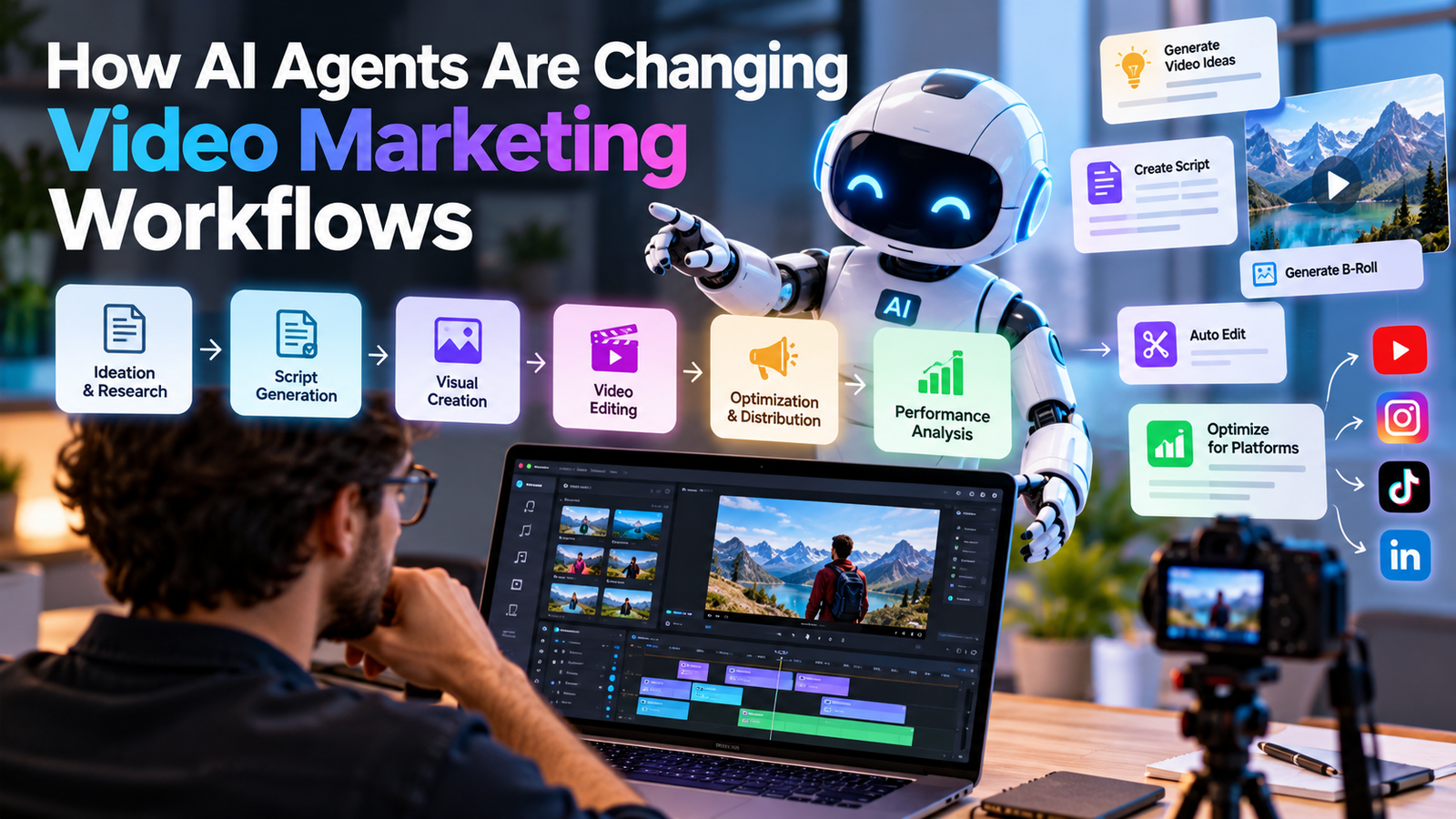
AI agents are changing video marketing workflows by replacing single-step tools with coordinated systems that plan, write, generate, and assemble video content with limited human supervision. Instead of a marketer manually writing a script, generating clips one at a time, and editing them together, AI agents now handle multiple stages of production as a connected pipeline. This shift moves video marketing from a slow, linear production process toward a faster, more automated system capable of producing dozens of video variants for a fraction of the previous cost and time.
What Is an AI Agent in the Context of Video Marketing?
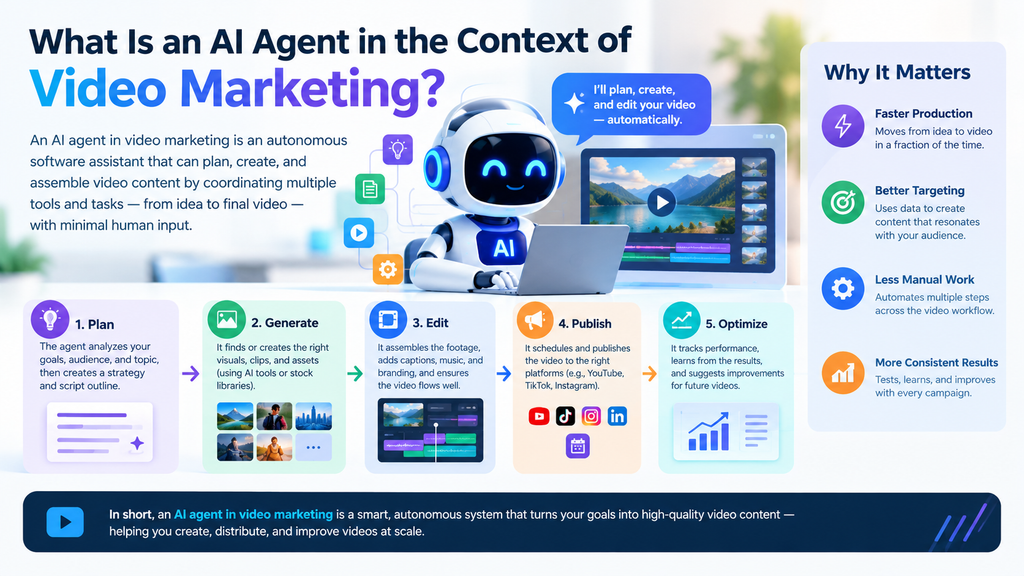
An AI agent is software that works toward a defined goal across multiple steps with limited supervision, rather than responding to a single prompt and stopping. In marketing, agents already research prospects, draft content, plan campaigns, and monitor channels, and when applied to video specifically, an agent extends this capability into planning a story, writing a script, proposing visuals, and building a preview the user can approve. This distinguishes an AI video agent from a basic AI video generator, which typically produces a single clip from a single prompt and requires a human to handle everything else.
The key difference is autonomy across steps. A traditional AI video tool generates one output per prompt, leaving a person responsible for stitching clips together, adding voiceover, and editing the final product. An AI agent handles that entire sequence as one coordinated task, checking in with a human only at key review points rather than after every micro-decision.
How Do Multi-Agent Workflows Handle Video Production?
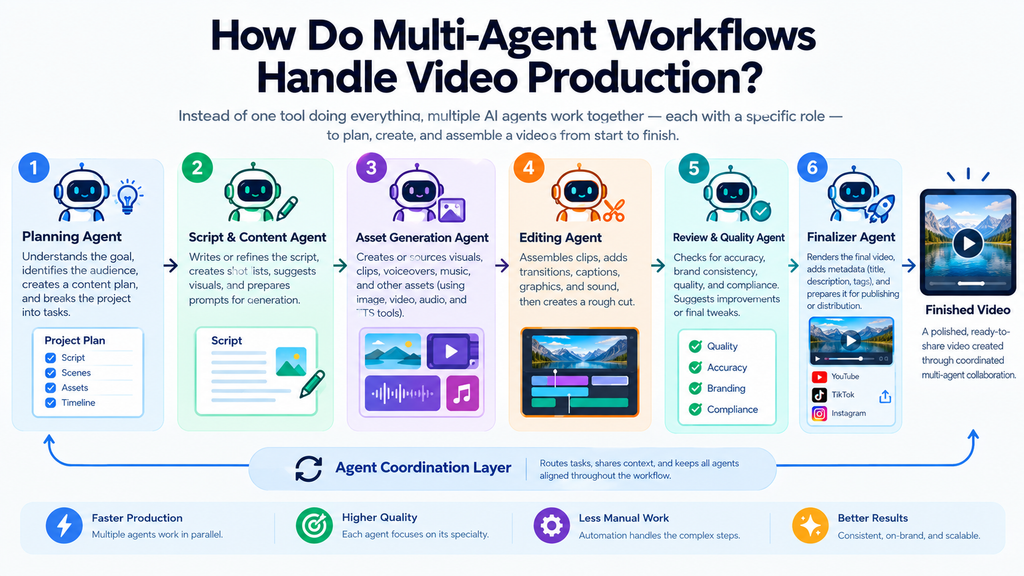
Multi-agent video workflows split the production process across several specialized AI agents, with each one handling a distinct task rather than a single model attempting the entire job. A multi-agent video workflow splits the video production process across multiple specialized AI agents, each handling one task, which typically breaks down into stages such as scripting, voiceover generation, visual creation, and final assembly. This specialization mirrors how a human production team would divide labor among a writer, voice talent, animator, and editor, except each role is filled by a dedicated AI agent working in sequence or in parallel.
This approach tends to outperform single-model systems because each agent can be optimized for its specific task rather than compromising across multiple skill sets at once. A model fine-tuned for script writing produces different output than one optimized for visual generation, and routing each task to the right specialized agent generally produces a more polished final result than forcing one general-purpose model to do everything.
What Does a Typical Multi-Agent Pipeline Look Like?
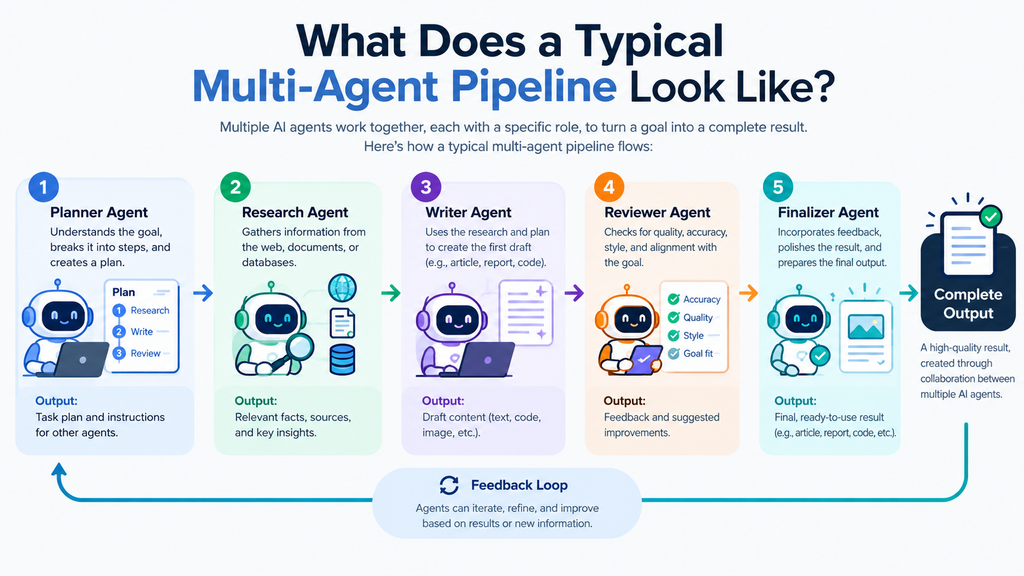
A typical pipeline moves through four core stages: script generation, scene planning, visual and voice production, and final editing. The process generally starts with a single prompt or brief, after which one agent drafts a script based on brand voice and audience, a second agent breaks that script into shot-by-shot scene descriptions, a third agent generates video clips from those descriptions, and a final agent assembles everything, including pacing, transitions, and audio syncing, into a finished video.
How Is This Different From Traditional AI Video Generation?
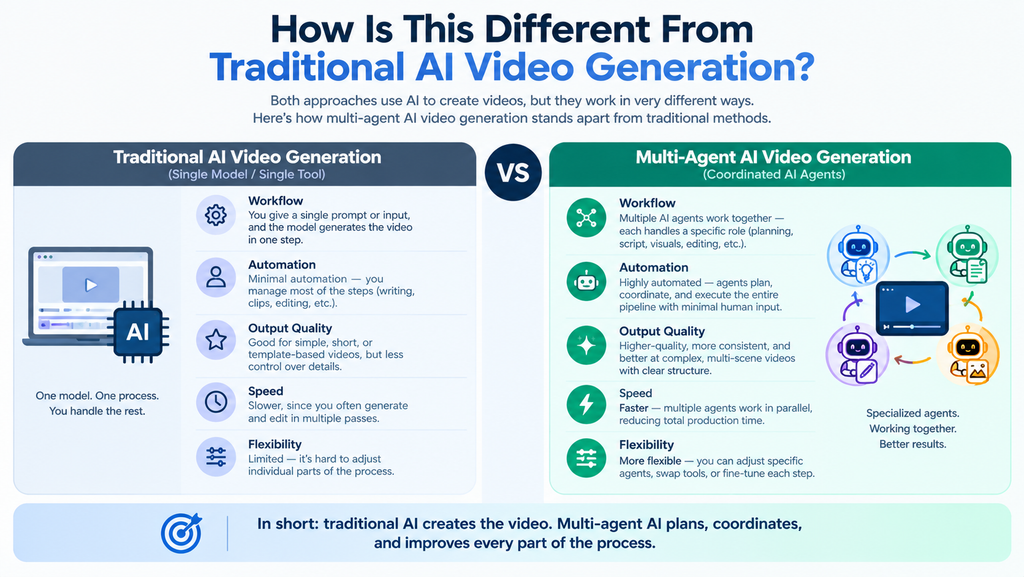
Traditional AI video generation produces a single clip per prompt, requiring separate manual steps for scripting, additional clip generation, and editing. AI video generation typically refers to a model turning a prompt into a single clip, which means a marketer still needs to write prompts for every scene individually, generate each clip separately, and manually assemble the pieces into a cohesive video. This approach works for one-off content but doesn’t scale well when a team needs dozens of localized or personalized video variants.
Agentic workflows close that gap by collapsing the entire pipeline into one coordinated process. Rather than generating isolated clips, the output becomes a complete, ready-to-publish video, meaning the agent handles scripting, scene planning, visual generation, voiceover, music, and editing from a single natural-language description rather than requiring a person to manage each step separately.
What Does “Text-to-Final-Cut” Mean?
Text-to-final-cut describes the shift from AI tools producing raw, unedited clips toward AI systems delivering a finished, publishable video from a single input. This matters for video marketing because it removes the editing bottleneck that previously required a skilled human editor to combine AI-generated clips, add transitions, sync audio, and ensure consistent pacing across a video.
How Are AI Agents Enabling Content Personalization at Scale?
AI agents allow marketing teams to generate large numbers of video variants from one core piece of content, swapping details like a viewer’s name, city, or product preference automatically. This practice, often called dynamic video personalization, lets a single campaign produce hundreds of tailored versions without requiring a video editor to manually rebuild each one. Instead of creating one generic ad for an entire audience, agents can generate segment-specific versions that speak more directly to individual viewer contexts.
This capability is particularly relevant for localization. In one documented example, Telenor Pakistan used an AI video platform to localize onboarding videos into Urdu, Sindhi, Pashto, and Balochi during the first quarter of 2026, demonstrating how agent-driven workflows can adapt a single piece of content across multiple languages without rebuilding the video from scratch for each market.
How Are Marketing Teams and Agencies Adopting Agentic Video Workflows?
Marketing agencies and brands are integrating agentic video tools directly into their production operations rather than treating them as experimental side projects. In February 2026, major global agencies including Serviceplan Group and Publicis Groupe partnered with an AI video platform to integrate the technology into their operations, signaling that agentic video workflows have moved from early experimentation into standard agency practice at a significant scale. This kind of adoption by established agencies suggests the shift isn’t limited to smaller, AI-native marketing teams.
Industry research groups have also started treating this shift as a planning priority rather than a future consideration. Industry analysts including eMarketer and IAB have flagged agentic workflows as a 2026 planning priority for brand and performance marketers, particularly for short-form social ads where volume and speed matter more than a single hero asset, reflecting how video advertising strategy is adjusting around the assumption that production speed and volume now matter as much as individual creative quality.
What Are the Practical Benefits for Marketing Teams?
The most immediate benefit is a dramatic reduction in production time and cost compared to traditional video production methods. API access enables high-volume automation, reducing production timelines from hundreds of weeks of collective labor to just 75 to 150 hours with AI-driven workflows, which allows marketing teams to produce consistent, high-quality video content at a pace that would be impractical with traditional camera crews, editors, and voice talent. This shift particularly benefits teams that previously had to limit video output due to budget or staffing constraints.
A second major benefit is narrative consistency across longer or serialized content. Character consistency, once a significant limitation of AI-generated video, has improved enough that narrative formats like branded drama series and ongoing campaign storylines are now viable using AI-driven production, a capability that wasn’t reliably available in earlier generations of AI video tools.
What Are the Limitations and Risks of AI Agent-Driven Video Workflows?
A good script remains essential even with fully automated production, since automation speeds up execution but doesn’t replace strategic creative thinking. A great AI video built around a weak script or unclear message still underperforms, regardless of how efficiently the underlying agents handled production. Teams that treat agentic workflows purely as a technical upgrade, without investing in strong messaging and creative direction, tend to see diminishing returns despite faster output.
Brand consistency also becomes harder to manage as production scales. When thousands of autonomous agents generate micro-campaigns simultaneously across different platforms and audience segments, maintaining a coherent brand voice and visual identity requires more deliberate oversight than a traditional single-production-team model, where consistency was easier to enforce through a smaller group of human reviewers.
Common Misconceptions About AI Agents in Video Marketing
A common misconception is that AI video generation and agentic video production are the same thing. In reality, AI video generation refers to a model producing a single clip from a prompt, while agentic video production describes an entire coordinated system that plans, generates, and assembles a complete video with minimal manual intervention. Another misconception is that agentic video workflows are only useful for large companies with substantial budgets; in practice, many of these tools are built with tiered or subscription pricing specifically to make automated video production accessible to smaller teams and individual marketers.
Some teams also assume that full automation eliminates the need for human review entirely. In most effective implementations, agents handle the repetitive production work while a person still reviews briefs, approves scripts, and signs off on the final video before publishing, preserving quality control at key checkpoints rather than removing it altogether.
Conclusion
AI agents are reshaping video marketing by replacing single-step generation tools with coordinated, multi-agent pipelines that handle scripting, scene planning, visual production, and editing as one connected process. This shift has made high-volume, personalized, and localized video content practical at a scale and cost that traditional production methods couldn’t match, while still requiring strong creative direction and brand oversight to avoid diminishing returns. Readers interested in this topic further might also explore how agentic AI is being applied to broader marketing functions like campaign planning and customer research, or look into specific AI video platforms to compare their agentic capabilities directly.
Frequently Asked Questions (FAQs)
1. What are AI agents in video marketing?
AI agents are software systems that can manage multiple steps of video production with limited human supervision, including scripting, scene planning, visual generation, voiceovers, and editing.
2. How do AI agents change video marketing workflows?
AI agents connect tasks that traditionally required separate tools and manual work into a coordinated workflow. This can reduce production time, simplify editing, and help marketing teams create more content efficiently.
3. What is the difference between an AI video generator and an AI video agent?
An AI video generator typically creates a clip from a prompt, while an AI video agent coordinates multiple tasks to produce a more complete video. Agentic workflows may include scriptwriting, scene planning, voice production, and final assembly.
4. What is a multi-agent video production workflow?
A multi-agent workflow uses specialized AI agents for different production tasks. One agent may write the script, another plans the scenes, another generates visuals and voiceovers, and another helps assemble the final video.
5. How do AI agents help personalize video marketing?
AI agents can create variations of a core video for different audiences by adapting language, messaging, locations, or product details. This helps marketers deliver more relevant content across customer segments while reducing repetitive manual editing.
6. Can AI agents reduce video marketing costs?
Yes. By automating repetitive production tasks, AI agents can reduce some labor requirements and shorten production timelines. Actual savings depend on the tools used, project complexity, review requirements, and the amount of human editing needed.
7. What are the main risks of using AI agents for video marketing?
Key risks include inconsistent branding, inaccurate information, generic scripts, visual errors, and insufficient human oversight. Marketing teams should review scripts, verify claims, check generated assets, and approve final videos before publication.
8. Will AI agents replace human video marketers?
AI agents are more likely to automate parts of video production than eliminate the need for human marketers entirely. Creative strategy, storytelling, brand decisions, audience understanding, and final quality control remain important human responsibilities.