
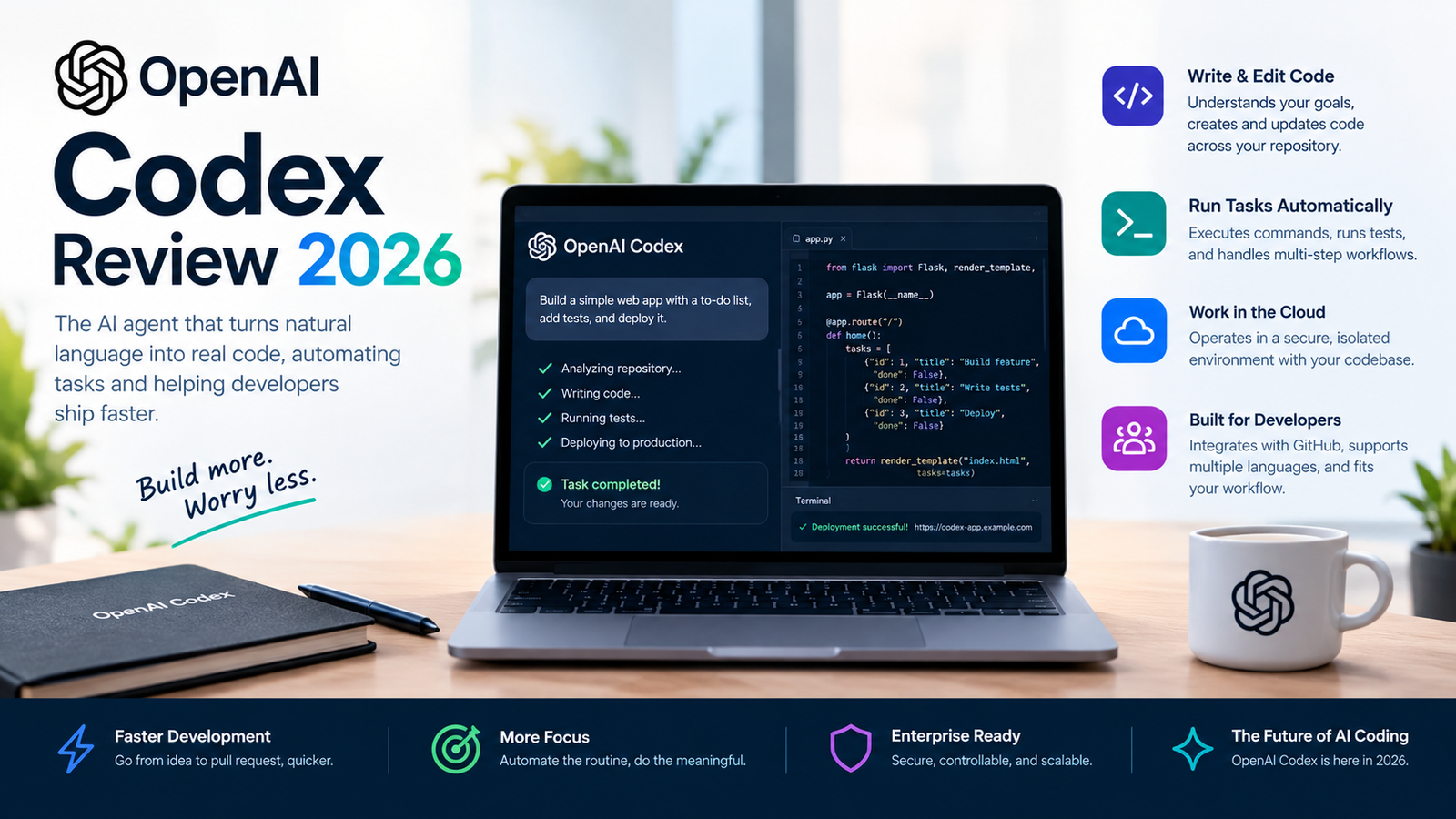
OpenAI Codex is an AI coding agent built into ChatGPT that can write code, fix bugs, run tests, and complete software engineering tasks either locally on a developer’s machine or in sandboxed cloud environments. In 2026, Codex evolved from a research preview into a full coding agent available as a desktop app, a command-line tool, an IDE extension, and a cloud-based task runner, with pricing bundled into ChatGPT’s subscription tiers rather than sold as a standalone product. This review breaks down what Codex actually does, how much it costs, and how it compares to other AI coding tools on the market.
OpenAI Codex 2026: Plans & Pricing Summary
Quick-reference tables for Codex’s subscription tiers, model specs, and how it compares to competing AI coding tools. Codex has no standalone price — access is bundled into ChatGPT plans.
Subscription Plans
| Plan | Price | What You Get |
|---|---|---|
| Free | $0/mo | Light, capped access to try Codex; no cloud integrations (GitHub review, Slack) |
| Go | $8/mo | Entry-level Codex usage for occasional tasks, higher limits than Free |
| Plus | $20/mo | Full cloud access: web, CLI, IDE extension, iOS; ~15–90 messages per 5-hour window |
| Pro | $200/mo | All-day agent runs, 5x–20x higher usage than Plus |
| Pro 500 | $500/mo | Parallel agents, latency-sensitive work, Astra Ultrafast inference |
| Business | $25/user/mo ($20 billed annually) | SAML SSO, MFA, no default data training, 2-user minimum |
Billing switched from per-message caps to token-based credits on April 2, 2026 (~4 cents per credit, rolling 5-hour window).
Model Specs
| Model | Released | Context Window | Input / Output Cost (per MTok) | SWE-bench Verified |
|---|---|---|---|---|
| GPT-5.3 Codex | Feb 5, 2026 | 400,000 tokens | $1.75 / $7.00 | 77.3% |
| GPT-5.4 | Mar 5, 2026 | 1.05M tokens | $2.50 / $15.00 | 80.0% |
Codex vs Competitors
| Tool | Entry Price | Multi-Agent Approach | Best Model SWE-bench |
|---|---|---|---|
| OpenAI Codex | $20/mo (Plus) | App-based worktrees | 80.0% (GPT-5.4) |
| Claude Code | $20/mo | Agent Teams (tmux) | 80.8% (Opus 4.6) |
| Cursor | $20/mo | — | — |
| GitHub Copilot | Varies | GitHub ecosystem integration | — |
Key Timeline
| Date | Milestone |
|---|---|
| May 16, 2025 | Codex Cloud research preview announced (powered by codex-1 / o3) |
| Feb 2026 | Desktop Codex app released for macOS/Windows |
| Mar 2026 | GPT-5.4 released; Codex reaches 2M+ weekly active users |
| Mar 2026 | Codex Security (app-security agent) introduced |
| Apr 2, 2026 | Billing switched to token-based credits |
| Apr 9, 2026 | Pro 5x tier added |
| Jul 9, 2026 | Codex app merged into ChatGPT desktop app |
| Jul 12, 2026 | 5-hour limit temporarily lifted for Plus/Pro/Business |
| Sep 29, 2026 | Pro 500 tier and Astra Ultrafast announced |
Pricing and limits are subject to change — verify current rates on OpenAI’s official pricing page before purchasing.
What Is OpenAI Codex and How Did It Develop in 2026?
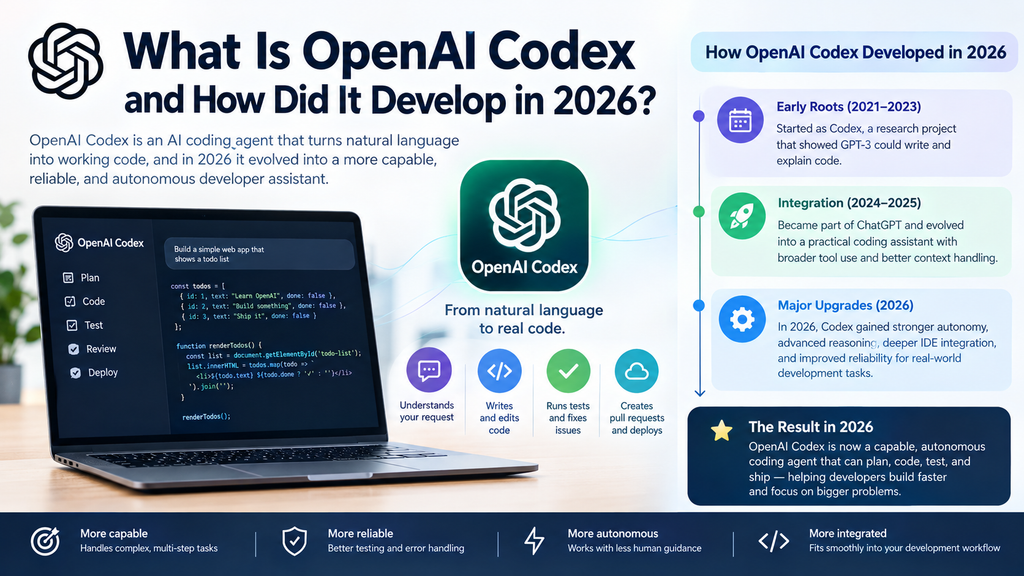
OpenAI Codex is an AI-powered coding agent that handles software development tasks semi-autonomously, writing features, answering questions about a codebase, fixing bugs, and proposing code changes for human review. OpenAI announced a research preview of Codex Cloud on May 16, 2025, initially powered by codex-1, a version of the o3 reasoning model optimized for software engineering. The tool has expanded significantly since that initial preview, moving from a narrow cloud-based experiment into a broader platform spanning multiple interfaces and models.
Several milestones defined Codex’s 2026 development. OpenAI released a desktop Codex app in February 2026, followed by GPT-5.4 for Codex on March 5, 2026. By March 2026, Codex had grown to more than 2 million weekly active users, and OpenAI merged the Codex app with the ChatGPT desktop app on July 9, 2026, consolidating the coding agent directly into OpenAI’s main consumer application. Notably, Reuters reported in April 2026 that competitive pressure from Anthropic’s Claude Code had led OpenAI to redirect resources toward Codex and enterprise tools as part of a broader strategic refocus, reflecting how competitive the AI coding assistant space became throughout the year.
What Core Features Does Codex Offer?
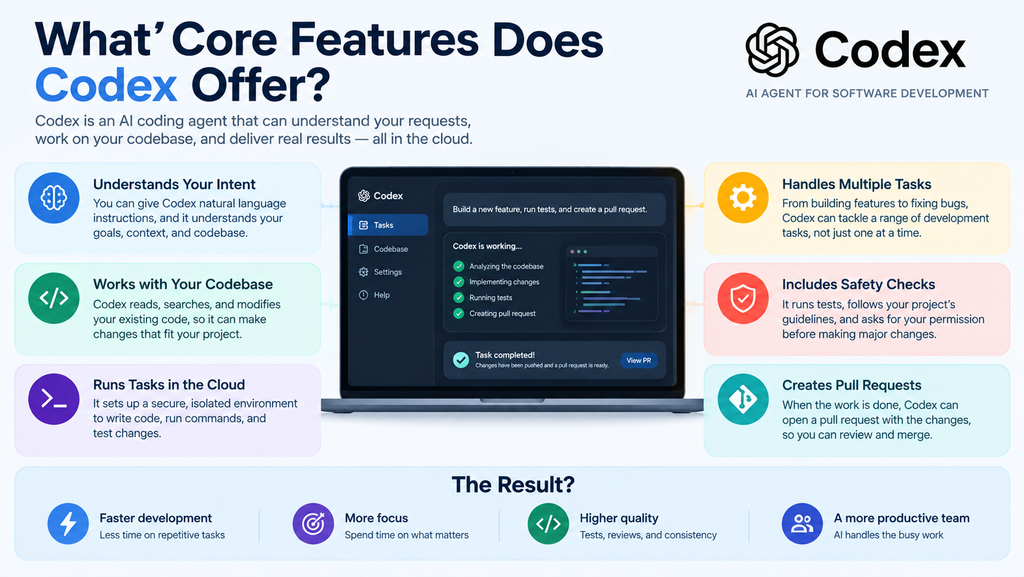
Codex functions across four main interfaces, each suited to a different kind of workflow. The Codex app is a desktop agent for macOS and Windows with plugin support for tools like Slack, GitHub, and Figma, while cloud tasks allow sandboxed repository work, including features, tests, and refactors, to run in parallel without requiring a local machine to stay on. For developers who prefer working in the terminal, the Codex CLI is an open-source, Apache 2.0-licensed terminal agent that can run locally, including against a developer’s own API key rather than a ChatGPT plan.
Beyond writing code, Codex includes automation and security-focused tools aimed at reducing manual review work. A code review agent performs automated pull request review within a plan’s usage limits, and OpenAI introduced Codex Security in March 2026, an application-security agent designed to identify and propose fixes for vulnerabilities. Together, these features position Codex less as an autocomplete tool and more as an agent capable of handling multi-step engineering tasks with limited supervision.
What AI Models Power Codex?
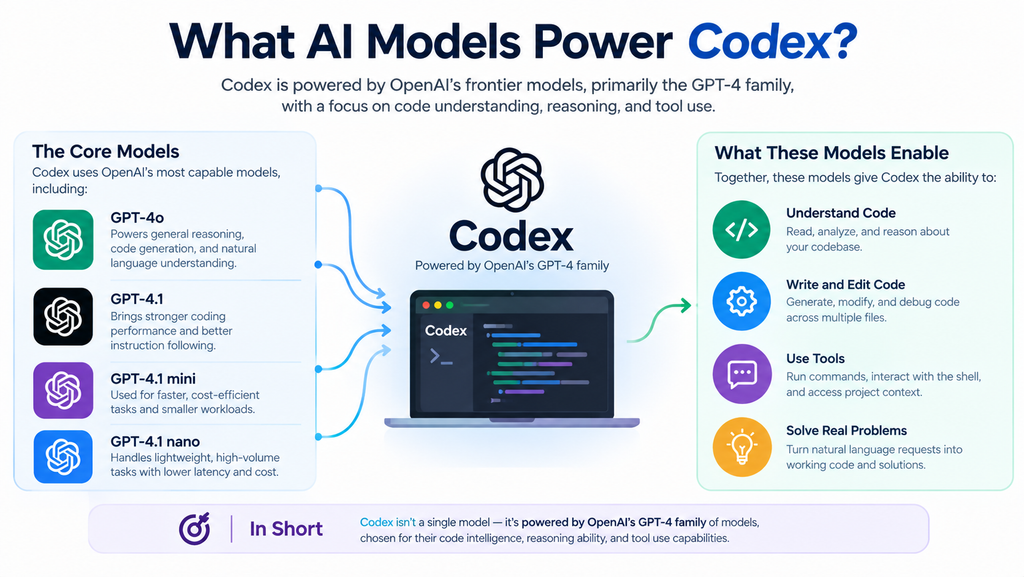
Codex runs on OpenAI’s specialized coding models, which have been updated multiple times throughout 2026 with meaningful jumps in capability and context size. GPT-5.3 Codex, released February 5, 2026, offers a 400,000-token context window with input costs of $1.75 per million tokens and output costs of $7.00 per million tokens, scoring 77.3% on the SWE-bench Verified benchmark. Its successor, GPT-5.4, released March 5, 2026, expanded the context window to 1.05 million tokens, raised pricing to $2.50 input and $15.00 output per million tokens, improved the SWE-bench Verified score to 80.0%, added native computer use capability, and expanded reasoning levels from two to five. By later in 2026, OpenAI had introduced further updates including GPT-5.5 for ChatGPT Plus users and an experimental GPT-5.3-Codex-Spark model built for faster response times.
How Much Does OpenAI Codex Cost in 2026?
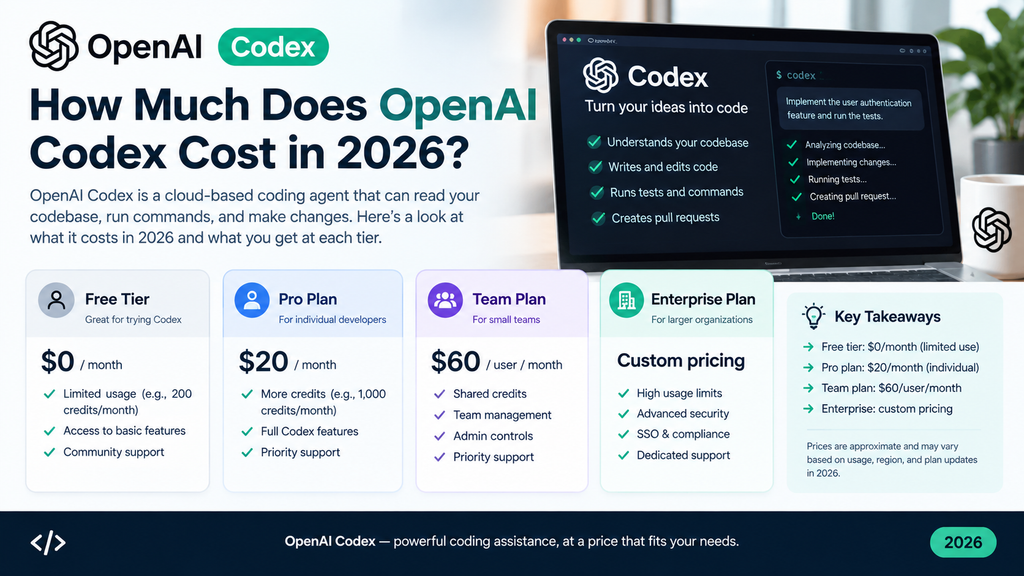
Codex pricing is bundled entirely into ChatGPT subscription plans rather than sold as a separate product, meaning the price a developer pays for ChatGPT determines their Codex access. There’s no separate Codex subscription — access scales with whichever ChatGPT plan a user already has. As of late 2026, the lineup spans six main tiers: Free, Go, Plus, Pro, Pro 500, and Business, with Enterprise available on a custom credit pool for larger organizations.
What Do the Specific Plans Include?
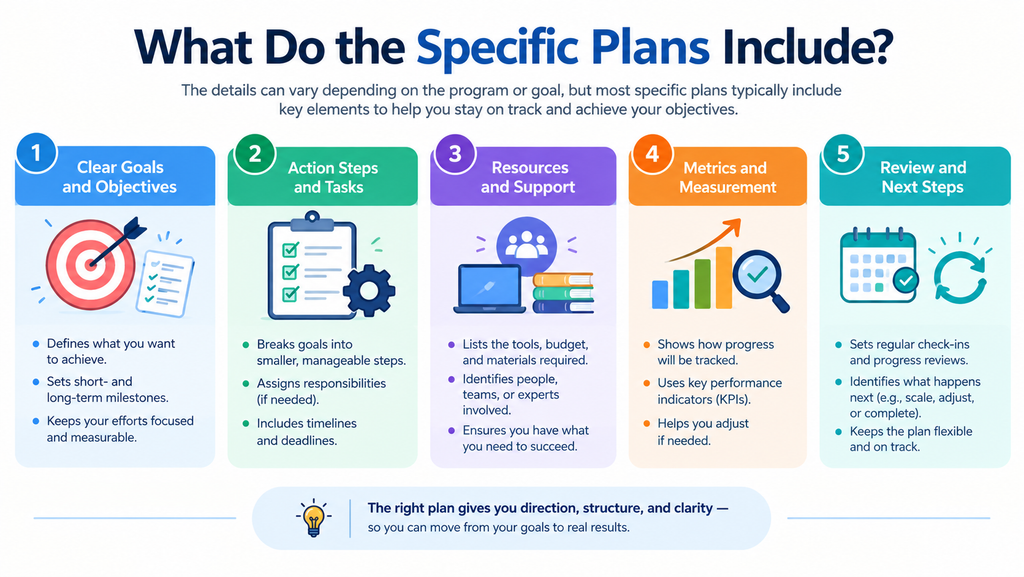
The Free tier provides light, capped access suitable mainly for evaluating the tool, while paid tiers scale up significantly in usage and features. The Go plan costs $8 per month for lightweight tasks with higher limits than Free, while Plus at $20 per month provides Codex access across web, CLI, IDE extension, and iOS, with roughly 15 to 90 local messages per five-hour window depending on the model used. At the higher end, Pro pricing reaches $200 per month for all-day agent runs, while a Pro 500 tier at $500 per month adds support for parallel agents and latency-sensitive work alongside a faster inference option OpenAI calls Astra Ultrafast. For teams, Business pricing runs $25 per user per month, or $20 per user per month billed annually with a two-user minimum, and includes SAML SSO, multi-factor authentication, and a default of no training on customer data.
Did Codex’s Billing Model Change During 2026?
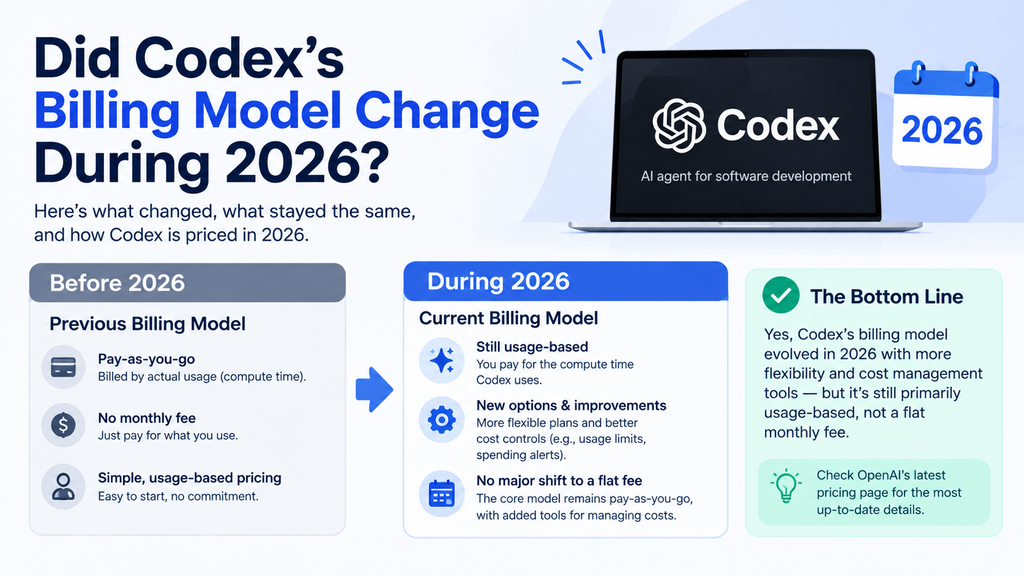
Yes, OpenAI shifted from message-based caps to token-based credit billing partway through the year. The billing model changed on April 2, 2026, when OpenAI retired the old per-message caps in favor of API-aligned credits, priced at roughly four cents each and measured on a rolling five-hour window. OpenAI also temporarily lifted the five-hour usage limit for Plus, Pro, and Business plans starting July 12, 2026, though a separate weekly cap still set the practical ceiling on usage, and the company indicated the shorter window could return.
How Does Codex Compare to Claude Code, Cursor, and GitHub Copilot?
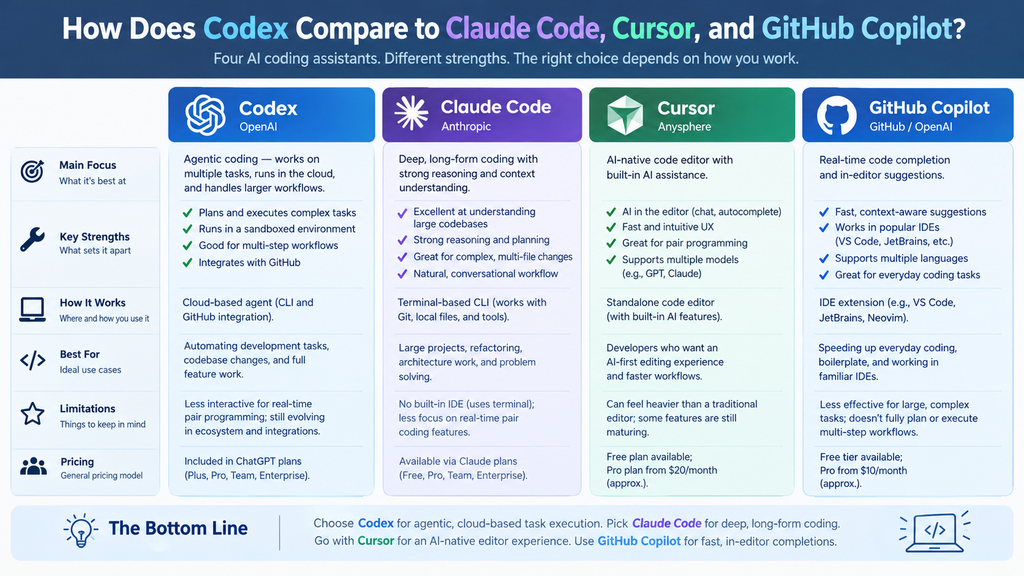
Codex competes directly with several established AI coding tools, each with different pricing structures and technical strengths. On raw coding benchmark performance, the gap between leading tools has narrowed considerably: GPT-5.4 scored 80.0% on SWE-bench Verified compared to Claude Opus 4.6’s 80.8%, putting the two models within roughly a single percentage point of each other on this widely cited coding benchmark. In terms of multi-agent capability, Codex relies on an app-based worktree system for running multiple agents in parallel, while Claude Code uses a tmux-based Agent Teams approach.
Pricing comparisons are complicated by each tool’s different billing structure. At the entry level, ChatGPT Plus at $20 per month gives access to Codex on web, CLI, IDE extension, and iOS, including cloud background agents, a price point that matches Claude Code’s standalone $20 per month plan and Cursor’s entry-level pricing. Because Codex access is tied to a broader ChatGPT subscription rather than a dedicated coding product, developers already paying for ChatGPT Plus for other purposes get Codex access at no additional cost, which is a meaningfully different value proposition than tools sold purely as developer products.
Common Misconceptions About OpenAI Codex
A common misconception is that Codex has its own standalone subscription price. In reality, OpenAI Codex has no standalone price — access is entirely bundled into whichever ChatGPT plan a user subscribes to, which means comparing “Codex pricing” to a dedicated coding tool’s price requires accounting for the full ChatGPT subscription cost, not just coding-specific usage. Another misconception is that free access to Codex is permanent; OpenAI initially offered all ChatGPT users, from Free through Enterprise tiers, two months of free access when the desktop app launched in February 2026, but this was a limited-time promotional window rather than an ongoing free tier with full capabilities.
Some developers also assume the Codex CLI requires a ChatGPT subscription. In fact, the Codex CLI is open-source and can be run locally against a developer’s own OpenAI API key entirely outside of any ChatGPT plan, which can be a more cost-effective option for occasional users who only pay for the tokens they actually consume rather than a flat monthly subscription.
Conclusion
OpenAI Codex in 2026 evolved into a comprehensive AI coding agent spanning desktop, CLI, IDE, and cloud environments, with pricing bundled into ChatGPT’s $0-to-$500-per-month tier structure rather than sold separately. Its competitive position against tools like Claude Code and Cursor has tightened considerably on raw benchmark performance, while its bundled pricing model offers a different value calculation than dedicated coding-only subscriptions. Developers evaluating Codex further might also look into its open-source CLI for pay-as-you-go API access, or compare its enterprise security features against other coding agents’ compliance offerings before committing to a specific plan.
Frequently Asked Questions (FAQs)
1. What is OpenAI Codex?
OpenAI Codex is an AI coding agent designed to help developers write code, fix bugs, understand codebases, run tests, and complete software engineering tasks with limited supervision.
2. What are the main features of OpenAI Codex in 2026?
Key features include AI-powered code generation, bug fixing, automated code reviews, cloud-based coding tasks, parallel agent workflows, and security analysis. It supports different development environments, including terminal-based and desktop workflows.
3. How much does OpenAI Codex cost in 2026?
According to the pricing structure described in this review, Codex access is bundled with eligible ChatGPT subscription plans rather than offered as a separate subscription. Costs and usage limits depend on the plan, so users should check OpenAI’s official pricing page for current details.
4. Can you use OpenAI Codex for free?
Limited Codex access may be available through the ChatGPT Free plan, depending on current eligibility and usage limits. Developers should verify the latest plan details to understand which features are available without a paid subscription.
5. What is the difference between OpenAI Codex and Claude Code?
Both tools help developers automate coding tasks, understand repositories, and work through complex software changes. Their interfaces, supported models, usage limits, integrations, and pricing structures differ, so the best choice depends on your development workflow and budget.
6. Can OpenAI Codex fix bugs and run tests automatically?
Yes. Codex can investigate code, propose fixes, make changes, and run tests as part of a coding task when the environment and permissions allow it. Developers should still review the changes and test results before merging code into production.
7. Does OpenAI Codex support multiple AI agents?
Codex supports workflows that allow multiple coding tasks or agents to work in parallel, depending on the available interface and plan. This can help developers handle separate features, bug fixes, or code reviews more efficiently.
8. Is OpenAI Codex worth using for software development?
Codex can be valuable for developers who want to automate repetitive coding tasks, accelerate debugging, and delegate multi-step engineering work. Its value depends on how well it performs on your codebase, the amount of human review required, and whether its usage limits and subscription cost fit your needs.