
ChatGPT and Grok are two of the most widely used AI chatbots in 2026, built by OpenAI and xAI respectively, and they take noticeably different approaches to the same core job of answering questions and assisting with everyday work. ChatGPT generally leads on ecosystem depth, workflow tools, writing quality, and coding reliability, while Grok’s main advantage is native, real-time access to X (formerly Twitter) posts and a more permissive, less filtered conversational style. Neither consistently outperforms the other across every task, so the better choice depends heavily on what a person actually needs the tool to do.ChatGPT vs Grok: Comparison Table (2026)
ChatGPT vs Grok: Comparison Table (2026)
A quick side-by-side look at how ChatGPT and Grok compare across the dimensions that matter most for everyday use.
| Attribute | ChatGPT | Grok |
|---|---|---|
| Developer | OpenAI | xAI (SpaceXAI) |
| Flagship model | GPT-6 Astra | Grok 4.6 |
| Real-time data | Web browsing (indexed) | Native live X firehose access |
| Coding | Stronger on benchmarks, Codex agent | Competitive on some benchmarks, Grok Build agent |
| Entry price | $20/mo (Plus) | $30/mo (SuperGrok) |
| Ecosystem | Canvas, Custom GPTs, Sora, Projects, Teams | Grok Imagine, open-source Grok-1, growing toolset |
| Context window | ~1.05M tokens | ~500K tokens |
ChatGPT leads on ecosystem depth, coding reliability, and structured workflows. Grok leads on real-time X data and cheaper API output tokens for high-volume use. Model versions and pricing change frequently — verify current details on each provider’s site.
What Are ChatGPT and Grok, and Who Makes Them?
ChatGPT is OpenAI’s flagship conversational AI product, while Grok is developed by xAI, the company founded by Elon Musk that has also operated under the name SpaceXAI. ChatGPT is widely integrated and used by over 180 million people weekly, making it the product against which most competitors are measured, while Grok was built with deliberately tighter integration into X, giving it a distinct identity centered on real-time social data rather than a general-purpose knowledge base alone.
Both companies release new model versions frequently, which means specific version numbers referenced in any comparison can become outdated within weeks. As of October 2026, ChatGPT’s current flagship is GPT-6 Astra, released September 3, 2026, alongside a faster everyday model called GPT-5.6 Luna, while Grok’s flagship is Grok 4.6, released August 12, 2026, with a faster variant called Grok 4.3 handling quicker interactions.
How Do ChatGPT and Grok Compare on Real-Time Information?
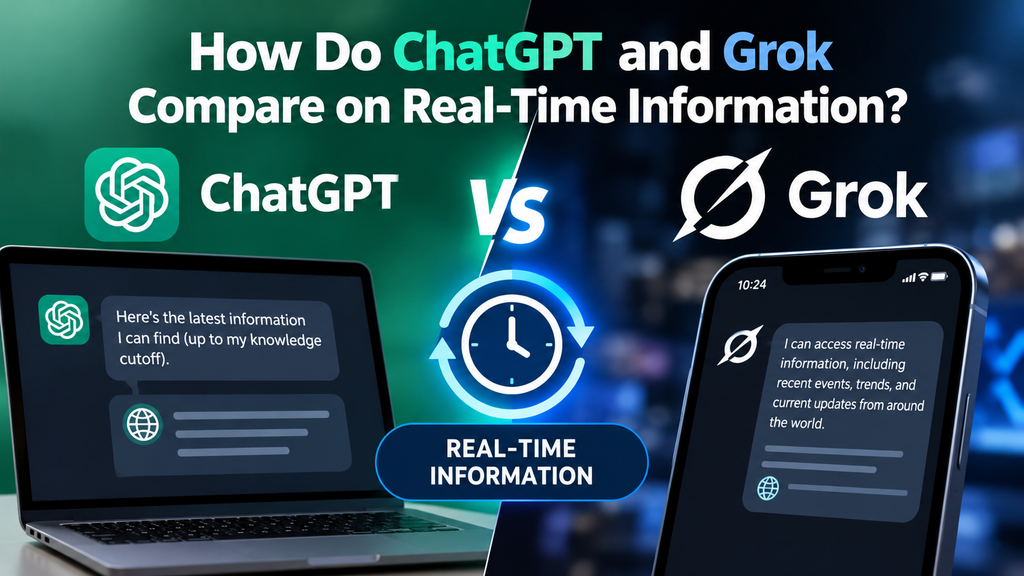
Grok has a clear and consistent advantage when it comes to real-time, up-to-the-minute information. ChatGPT browses the web via Bing, pulling indexed content on demand, while Grok has privileged first-party access to the X firehose, meaning it can surface breaking news and live social sentiment that hasn’t yet been indexed by traditional search. For topics like trending news, live events, or public reaction as it unfolds, Grok’s access to unindexed, real-time posts gives it a structural edge that ChatGPT’s search-based approach cannot fully replicate.
This doesn’t mean ChatGPT lacks real-time capability altogether. ChatGPT includes an on-demand web browsing tool that lets it pull current information when needed, but because that data comes through a search index rather than a live firehose, Grok retains the edge specifically for breaking news and current events.
How Do ChatGPT and Grok Compare on Coding and Reasoning?
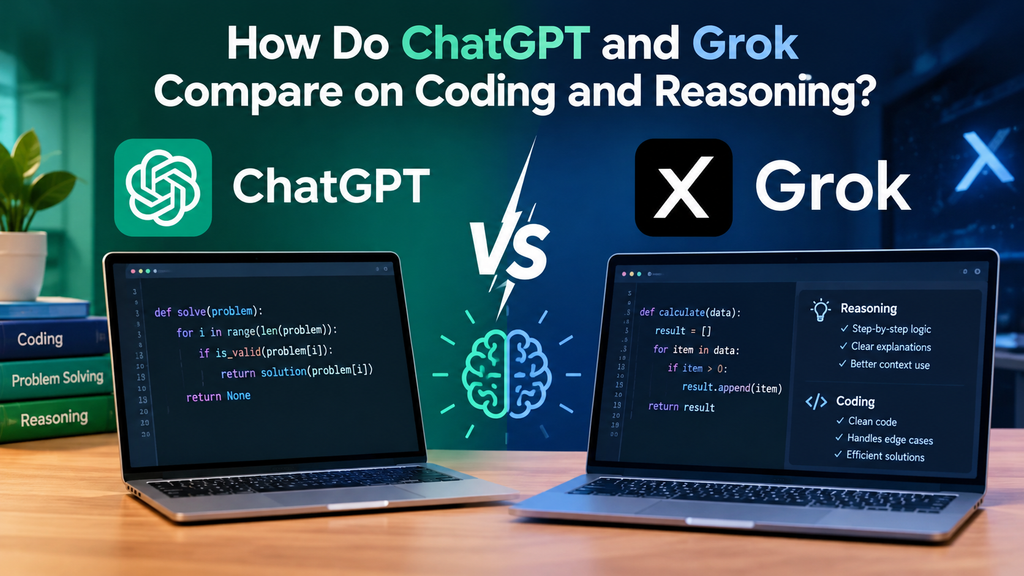
ChatGPT generally holds the advantage for production-grade coding and complex, multi-step reasoning tasks. ChatGPT scores higher than Grok on standard coding benchmarks and handles large, multi-file projects more reliably, which matters for developers working on substantial codebases rather than quick scripts. Each company also offers a dedicated coding agent, with ChatGPT offering Codex through its app, CLI, and cloud, while Grok offers Grok Build.
Independent benchmark results on long coding tasks show a closer race than the general reputation gap suggests. One vendor-reported comparison found Grok 4.7 scoring 46.3% versus GPT-5.6 Sol’s 41.7% on CursorBench, while the ChatGPT model led on a separate benchmark called DeepSWE, indicating that the gap between the two narrows or reverses depending on which specific coding benchmark is used.
How Do ChatGPT and Grok Compare on Pricing?
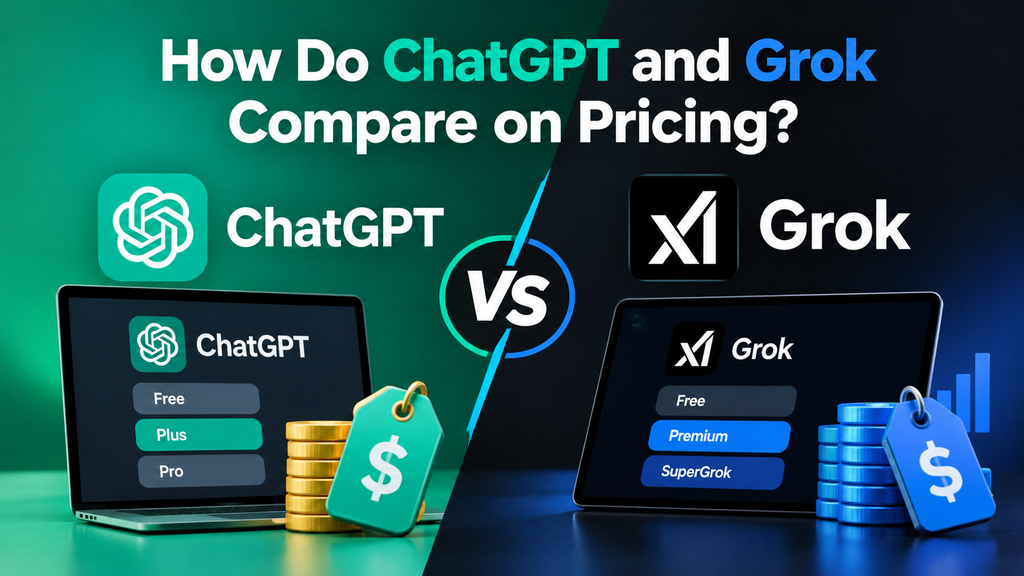
ChatGPT is generally the cheaper entry point for individual paid users, while Grok becomes more cost-effective for high-volume developers using the API. ChatGPT’s Plus subscription costs $20 per month, undercutting SuperGrok’s $30 per month, and ChatGPT bundles more features at that price point, including Canvas, Custom GPTs, Projects, and scheduled tasks. Grok offers tiered plans beyond its base SuperGrok subscription, including SuperGrok Lite at $10 per month and higher tiers like SuperGrok Plus at $100 per month and SuperGrok Heavy at $300 per month for users who need more capability or higher usage limits.
At the API level, the cost comparison flips in Grok’s favor for high-volume, output-heavy use. For output-heavy API usage, Grok 4.7 costs roughly $6 per million tokens compared to GPT-6 Sol’s $10 per million, while for cache-heavy workloads ChatGPT’s cached input pricing of $0.20 per million undercuts Grok’s $0.50. This means the cheaper option genuinely depends on how a developer’s specific workload is structured rather than one platform being universally less expensive.
How Do ChatGPT and Grok Compare on Tools and Ecosystem?
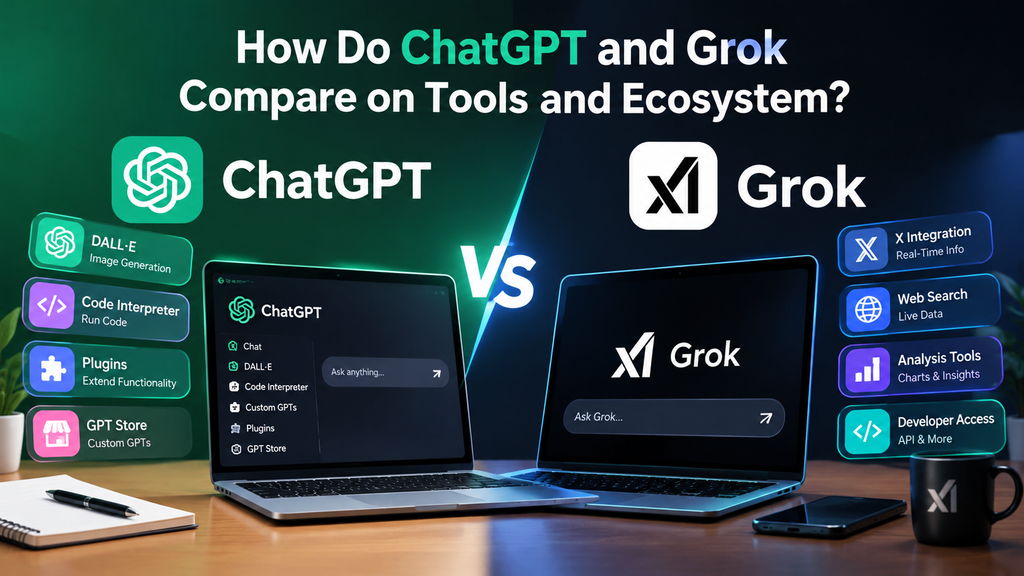
ChatGPT offers a substantially larger and more mature set of surrounding tools and integrations. Its ecosystem includes Canvas for Google Docs-style collaboration, Custom GPTs, Projects, scheduled tasks, Team and Enterprise plans, and video generation through Sora, most of which Grok does not currently match in scope. ChatGPT also connects to external storage and productivity tools; its library connectors reach Google Drive, Box, Dropbox, and SharePoint, according to OpenAI’s own release notes.
Grok’s ecosystem is smaller but growing, with its most distinctive strength remaining tight X integration rather than broad third-party connectivity. Grok is available through both x.com/i/grok and the standalone grok.com, while ChatGPT is available through chatgpt.com and its own apps. One area where Grok stands apart structurally is openness: Grok has released some of its models as open-source, specifically Grok-1, while ChatGPT’s models remain closed and proprietary.
How Do ChatGPT and Grok Compare on Content Policy and Tone?
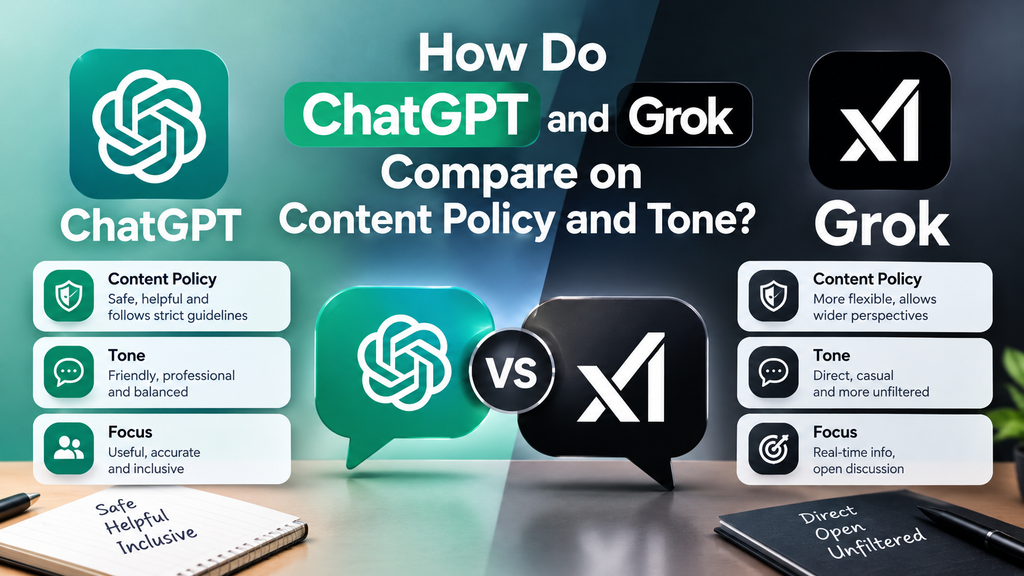
Grok is generally positioned as having a more permissive content policy and a more casual, opinionated conversational style compared to ChatGPT’s more structured and filtered approach. ChatGPT and Grok are built on different instincts, with ChatGPT vs Grok often coming down to ChatGPT’s broad, polished all-around performance against Grok’s more casual, opinionated tone. This distinction in personality and content restriction level is often cited as a primary reason some users prefer Grok specifically, independent of raw capability differences.
Which Model Is Better for Factual Accuracy?
Neither model should be treated as infallible on fast-moving or niche topics. Both models can make mistakes on niche or fast-moving subjects, so claims that need to be exactly right are worth double-checking against a primary source regardless of which model provided the answer.
Which One Should You Actually Use?
The right choice depends on the specific task rather than an overall “better” model. Grok is the stronger choice for live X context and cheaper output tokens, while ChatGPT is the stronger choice for workflows, study tools, and plugins. Someone who needs to track breaking news or gauge real-time public sentiment will likely get more value from Grok, while someone focused on long-form writing, structured research, coding projects, or team collaboration will generally find ChatGPT’s broader toolset more useful.
Many users in practice don’t treat this as an exclusive choice. Many people lean on Grok to stay current on events while using ChatGPT for focused work, using each tool for the specific strength it offers rather than committing to only one platform.
Common Misconceptions About ChatGPT and Grok
A common misconception is that Grok’s real-time access to X makes it more generally accurate than ChatGPT across all topics. In reality, real-time access helps specifically with breaking news and live social sentiment, but it doesn’t translate into better performance on structured reasoning, coding, or well-sourced long-form analysis, where ChatGPT typically performs better. Another misconception is that one platform is unambiguously cheaper than the other; as pricing comparisons show, ChatGPT tends to be cheaper for individual subscribers, while Grok can be cheaper for high-volume API developers, depending on the specific type of usage.
Conclusion
ChatGPT and Grok serve different strengths within the same broad category of AI chatbots, with ChatGPT leading on ecosystem maturity, coding reliability, and structured workflows, and Grok leading on real-time information access and lower-cost API output tokens. Rather than picking a single winner, the most practical approach is matching the tool to the task: Grok for staying current on fast-moving events, and ChatGPT for deep, structured work. Readers comparing AI assistants further might also look into how Google’s Gemini or Anthropic’s Claude fit into this same landscape, since both represent additional approaches to the same underlying question of how AI chatbots should balance reasoning, tool access, and up-to-date information.