
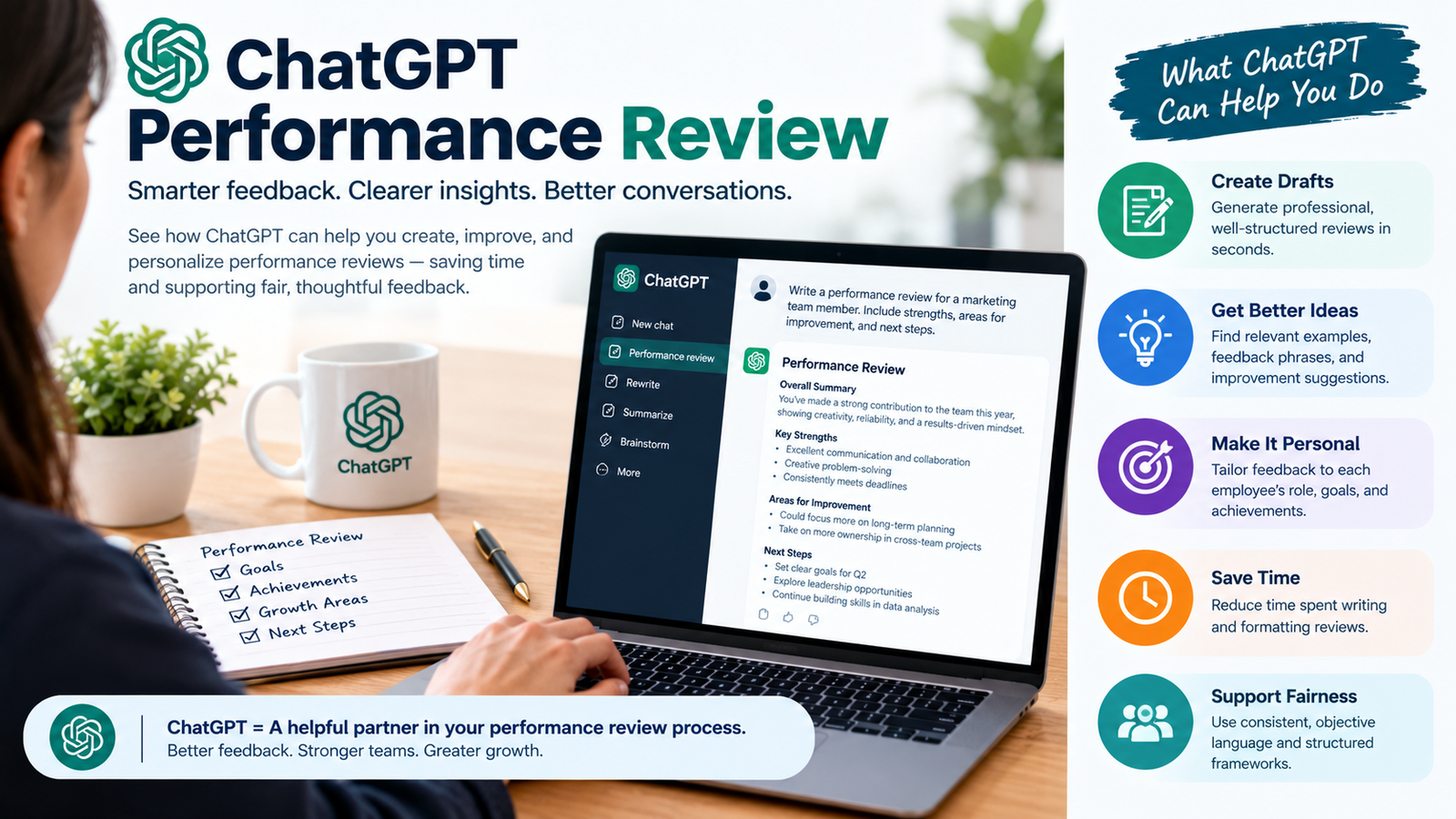
A ChatGPT performance review refers to using ChatGPT, OpenAI’s AI chatbot, to help draft, structure, or refine employee performance evaluations rather than writing them entirely from scratch. Managers and employees use it to turn rough notes, accomplishments, and feedback points into polished, professional review language, which saves time on an administrative task widely seen as tedious. It works best as a drafting assistant that still requires human judgment, specific examples, and a final review for accuracy before anything goes into an official record.
What Does a ChatGPT Performance Review Actually Involve?
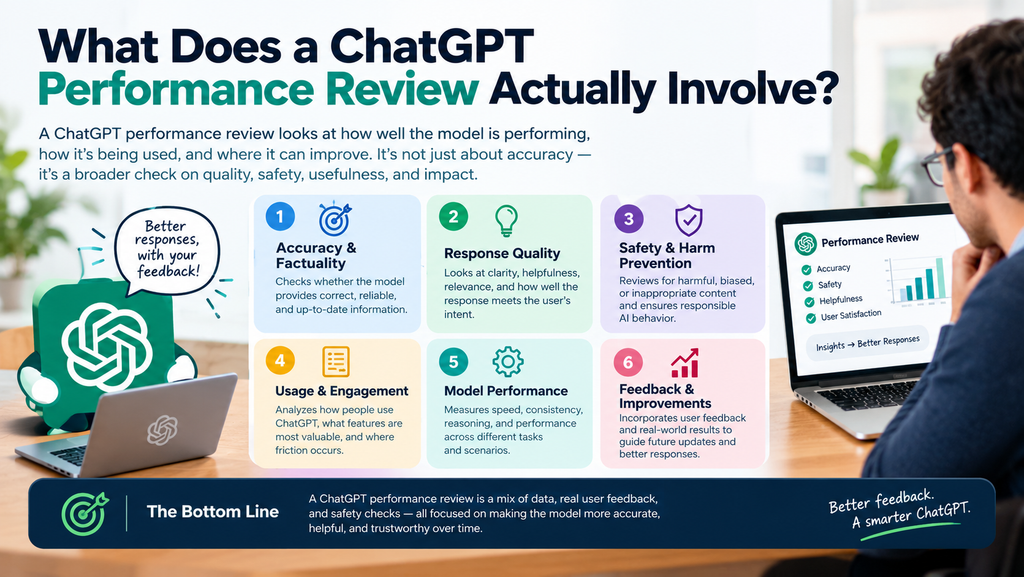
A ChatGPT performance review is the practice of feeding an employee’s accomplishments, feedback notes, or goals into ChatGPT and asking it to generate structured evaluation language. This typically means prompting the tool with specific details, such as a project outcome or a skill demonstrated, rather than asking it to invent feedback from nothing. The output usually needs editing and fact-checking before it becomes part of a formal review, since ChatGPT works from what it’s given rather than independent knowledge of an employee’s actual work.
This use case has become widespread enough that managers openly discuss it. One former manager described the traditional review process at large tech companies as exhausting, tedious, and bureaucratic, which is part of why so many managers and employees have turned to ChatGPT to speed up the writing portion of reviews.
Who Uses ChatGPT for Performance Reviews and Why?
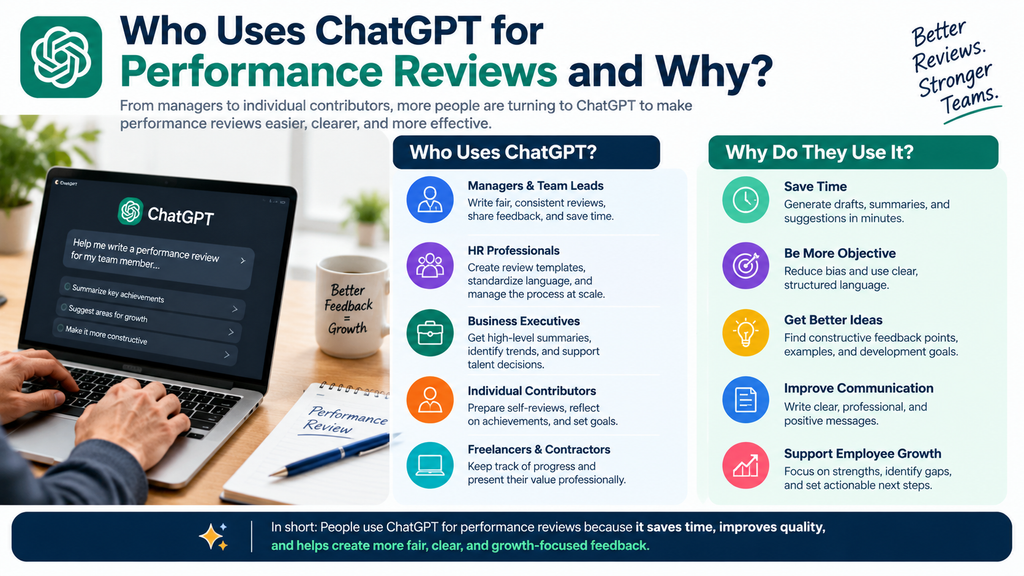
Both managers writing evaluations for their teams and employees drafting self-evaluations use ChatGPT for this purpose. Managers use it to turn scattered one-on-one notes into a coherent narrative, while employees use it to organize their own accomplishments into persuasive, well-structured self-assessments. One engineering director has described feeding a year’s worth of one-on-one notes into the enterprise version of ChatGPT and asking it to synthesize that material into an evaluation, producing what he calls a rough first draft rather than a finished product.
Employees report similar results when using ChatGPT for self-reviews. In one documented case, a professional experimenting with ChatGPT for an annual review found it could logically summarize accomplishments and produce a relevant introduction and conclusion, and noted that swapping the phrase “annual performance review” for “self review” in the prompt produced leaner, less flowery language than the original phrasing.
How Do You Write an Effective ChatGPT Performance Review Prompt?
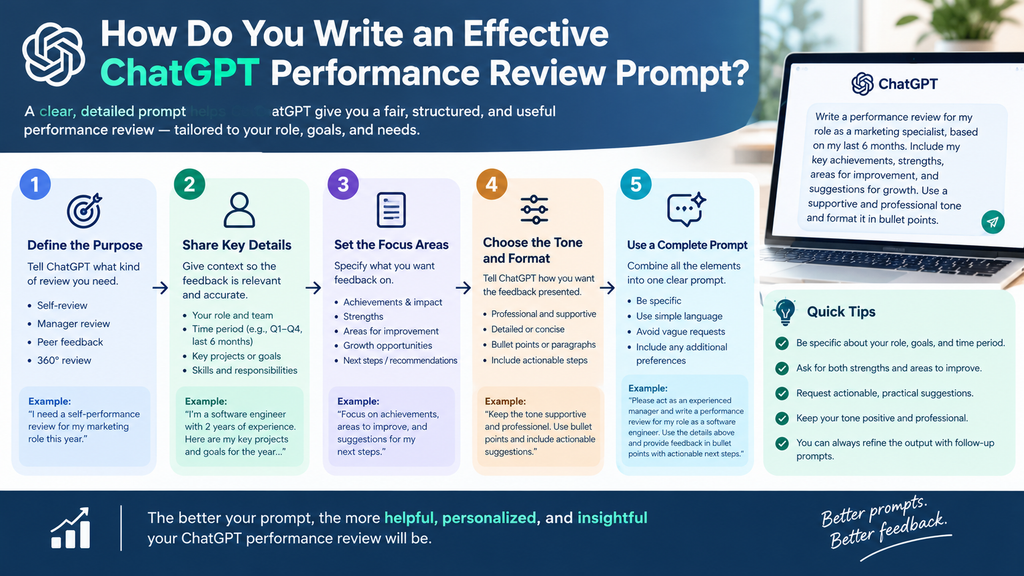
An effective prompt includes specific details rather than a vague request, since ChatGPT’s output quality depends heavily on the information it’s given. A weak prompt like “write a review for someone who did a good job” produces generic, unusable text, while a stronger prompt specifies the employee’s role, a concrete achievement, and the review period, such as asking ChatGPT to write feedback for a named employee in a specific job title who accomplished something specific during a defined timeframe. The more context supplied, the more the output reflects the actual person being evaluated rather than generic filler language.
What Should a Good Prompt Include?
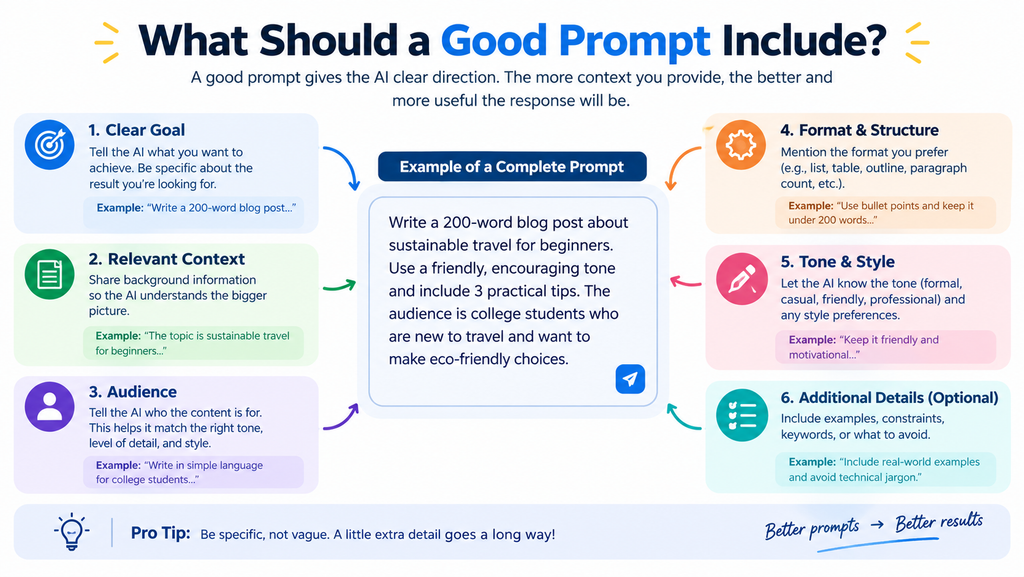
A strong prompt typically includes the employee’s role or job title, a specific achievement or project, the relevant time period, and the tone or feedback model desired. Structured frameworks like the “Start, Stop, Continue” model, which organizes feedback into what an employee should begin doing, stop doing, and keep doing, can be built directly into a prompt to produce more actionable output. Prompts can also be tailored to generate SMART goals, meaning goals that are specific, measurable, achievable, relevant, and time-bound, for the next review period.
What Are the Main Uses of ChatGPT in the Performance Review Process?
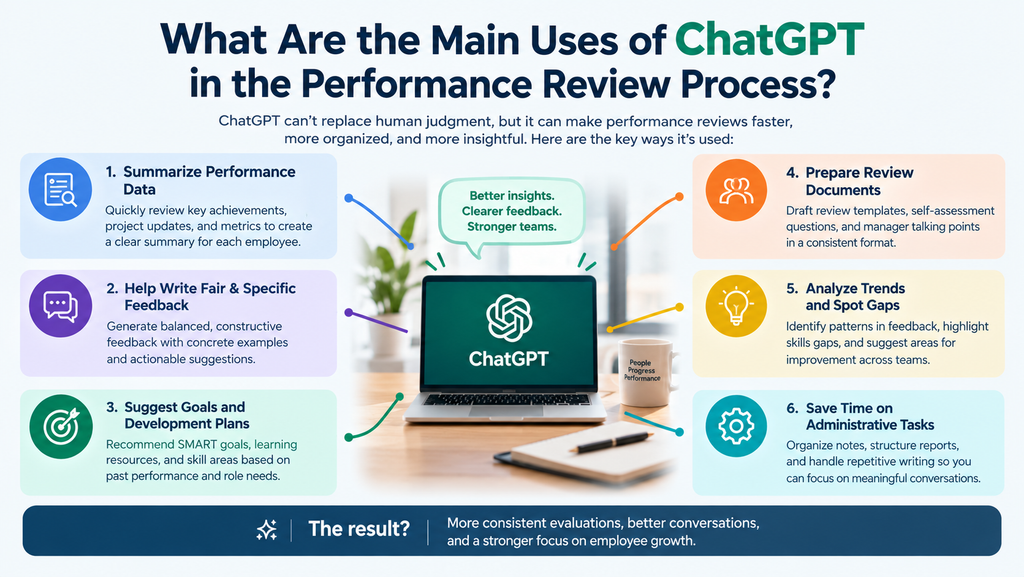
ChatGPT is most commonly used to draft review narratives, summarize accomplishments, generate forward-looking goals, and smooth out awkward phrasing in existing notes. Beyond simply writing feedback, it can help outline future objectives based on a performance discussion, which makes a review feel more actionable and forward-looking rather than purely evaluative of the past. It can also help with the factual, descriptive sections some review forms require before the evaluative commentary begins.
Can ChatGPT Write an Entire Performance Review on Its Own?
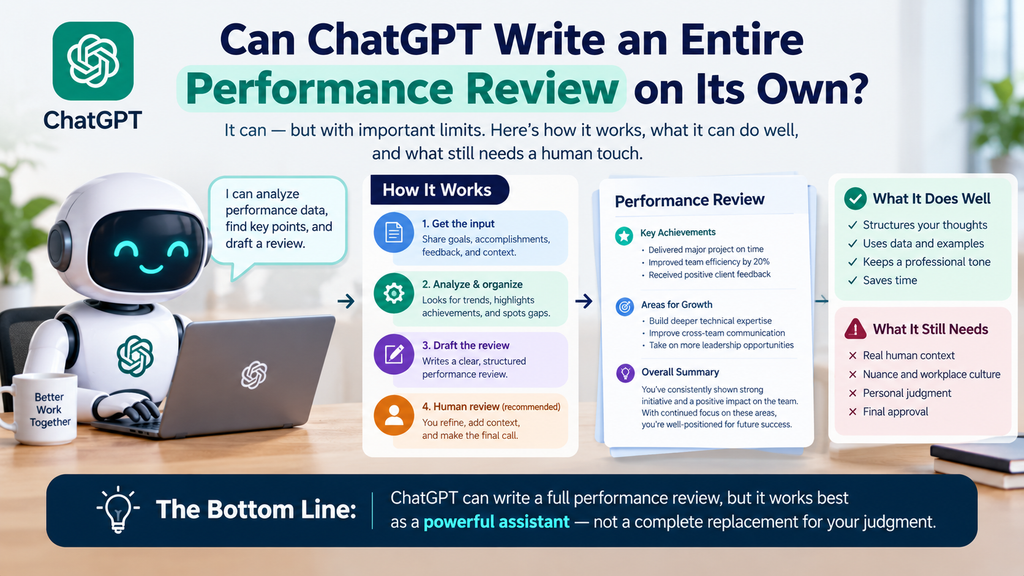
Yes, if given enough detailed information, ChatGPT can generate what functions as a complete performance review draft. However, the quality of that draft depends entirely on the specificity and accuracy of what’s fed into it; without real accomplishments, concrete examples, and context about the role, the output tends to read as generic rather than genuinely reflective of the employee’s actual contributions.
What Are the Risks of Relying on ChatGPT for Performance Reviews?
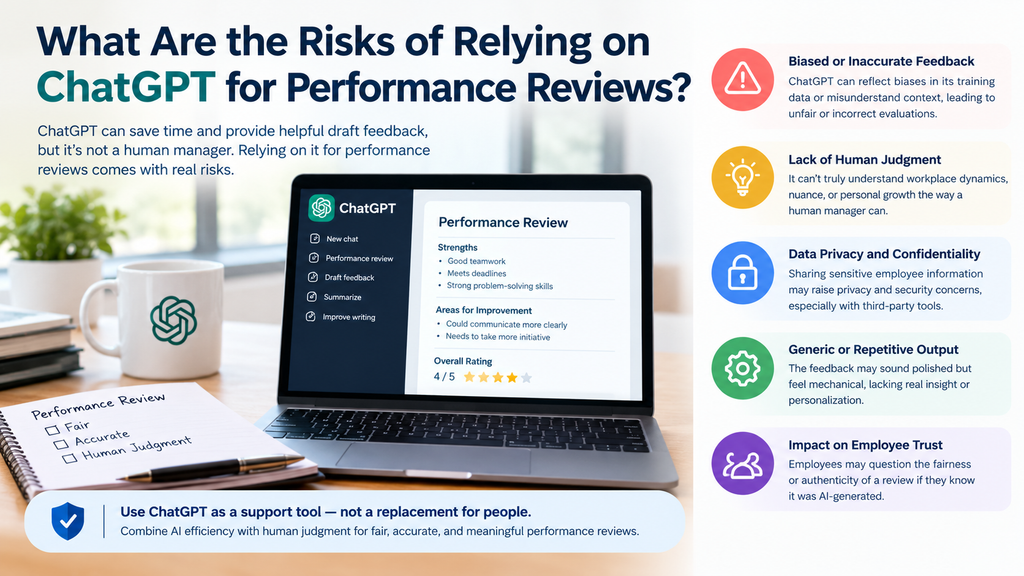
The main risk is inaccuracy, since ChatGPT can state incorrect information with full confidence if a user doesn’t carefully verify the facts it includes. Reviewers should double-check any AI-generated details, metrics, or claims before including them in an official document, because an inaccurate statement in a formal performance review can have real consequences for an employee’s career and compensation. ChatGPT should function as a supporting tool that accelerates the writing process, not a replacement for a manager’s direct knowledge of an employee’s actual performance.
Can Employees Tell When a Review Was Written by AI?
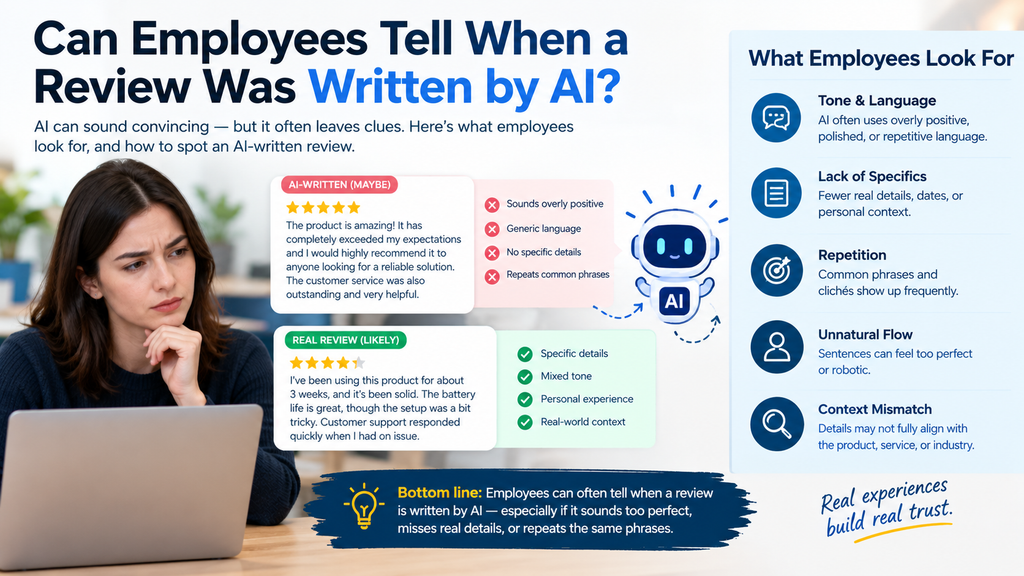
Often, yes. AI-generated writing tends to carry a recognizable tone and structure, and employees and colleagues who regularly use ChatGPT themselves have reported being able to spot it in reviews written by others. This matters because a performance review perceived as impersonal or generic, even if accurate, can undermine the trust and relationship-building purpose that reviews are meant to serve, which is why most guidance recommends using AI output as a starting draft rather than a final product.
Common Misconceptions About Using ChatGPT for Performance Reviews
A common misconception is that ChatGPT can independently evaluate an employee’s performance. In reality, it has no access to an employee’s actual work unless the user manually provides notes, project outcomes, or specific examples, meaning the quality of any review depends entirely on the human-supplied input rather than any independent assessment by the AI. Another misconception is that using ChatGPT eliminates the need for a manager to prepare before writing a review; effective use still requires gathering specific examples and clarifying review objectives beforehand, much like preparing ingredients before cooking.
Some users also assume AI-written reviews save all the time involved in the review process. In practice, most experienced users describe ChatGPT’s output as a first draft that still requires editing, fact-checking, and personalization rather than a finished, ready-to-submit document.
Conclusion
A ChatGPT performance review works best as a collaborative process: the manager or employee supplies specific accomplishments and context, and ChatGPT organizes that material into clear, professional language that would otherwise take significantly longer to write from scratch. The tool consistently proves useful for structuring narratives, generating SMART goals, and smoothing out phrasing, but it cannot replace direct knowledge of an employee’s actual work or the fact-checking needed before a review becomes official. Readers interested in this topic further might also explore structured feedback frameworks like “Start, Stop, Continue,” or broader best practices for writing SMART goals in professional development plans.
Frequently Asked Questions (FAQs)
1. What is a ChatGPT performance review?
A ChatGPT performance review involves using AI to draft, organize, or improve employee evaluations based on real accomplishments, feedback, and performance notes.
2. Can ChatGPT write an entire employee performance review?
Yes. ChatGPT can create a complete performance review draft when provided with sufficient information about the employee’s role, achievements, strengths, and areas for improvement. A human should always review the final version.
3. How do managers use ChatGPT for performance reviews?
Managers use ChatGPT to summarize employee accomplishments, organize feedback, improve review language, identify development opportunities, and create professional evaluation drafts.
4. What should I include in a ChatGPT performance review prompt?
Include the employee’s job title, review period, specific accomplishments, measurable results, strengths, areas for improvement, and preferred writing tone.
5. Can ChatGPT help employees write self-performance reviews?
Yes. Employees can use ChatGPT to organize their achievements, highlight important contributions, describe challenges, and prepare professional self-evaluations.
6. Can ChatGPT generate SMART goals for employee performance reviews?
Yes. ChatGPT can help create SMART goals that are Specific, Measurable, Achievable, Relevant, and Time-bound, making future performance expectations clearer.
7. What are the risks of using ChatGPT for employee evaluations?
Potential risks include inaccurate information, generic feedback, privacy concerns, and biased or misleading language. All AI-generated content should be checked by a responsible human reviewer.
8. Can employees recognize a performance review written by ChatGPT?
Sometimes. AI-generated reviews may sound overly formal, repetitive, or generic. Adding specific examples, authentic observations, and personalized feedback makes evaluations more natural and meaningful.