
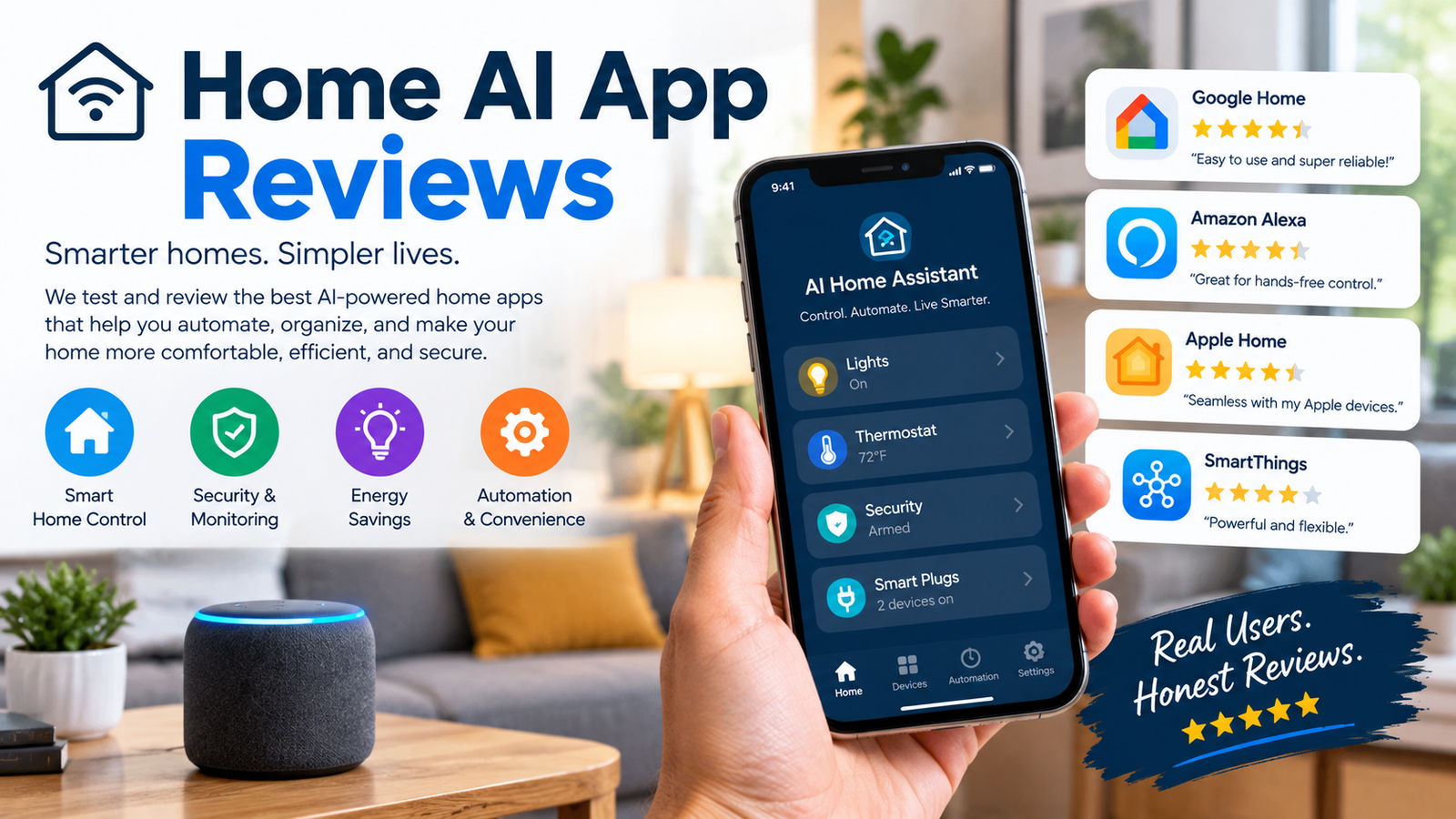
Home AI apps in 2026 span several distinct categories, including interior design and renovation visualization, smart home voice control, household management, and DIY repair diagnosis, with no single app dominating every category. The right choice depends entirely on what a homeowner needs: visualizing a room redesign, controlling connected devices, keeping a family calendar organized, or diagnosing a broken appliance. This guide reviews the top-performing apps in each major category based on recent head-to-head testing.
What Are Home AI Apps and How Are They Categorized?
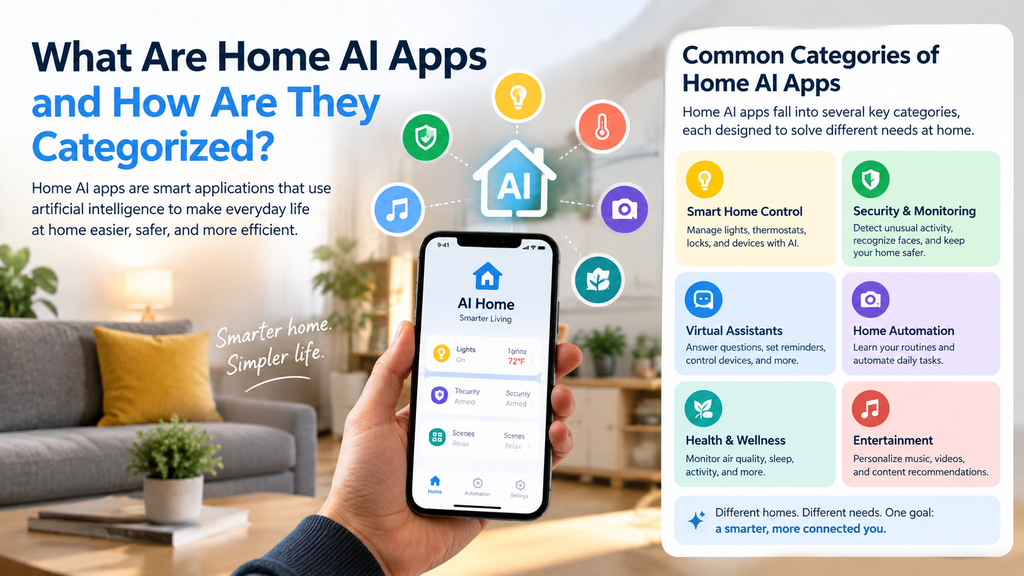
Home AI apps use artificial intelligence to help with tasks related to living spaces, ranging from visual design to physical repairs to household administration. These apps generally fall into four categories: AI interior and exterior design tools that generate room renders from photos, AI assistants that control smart home devices through voice commands, AI household managers that handle scheduling and family logistics, and AI repair or troubleshooting tools that diagnose problems with home systems and appliances. Understanding which category a need falls into is the first step toward choosing the right app, since a design tool and a repair tool solve entirely different problems despite both being labeled “home AI.”
What Are the Best AI Interior Design Apps in 2026?
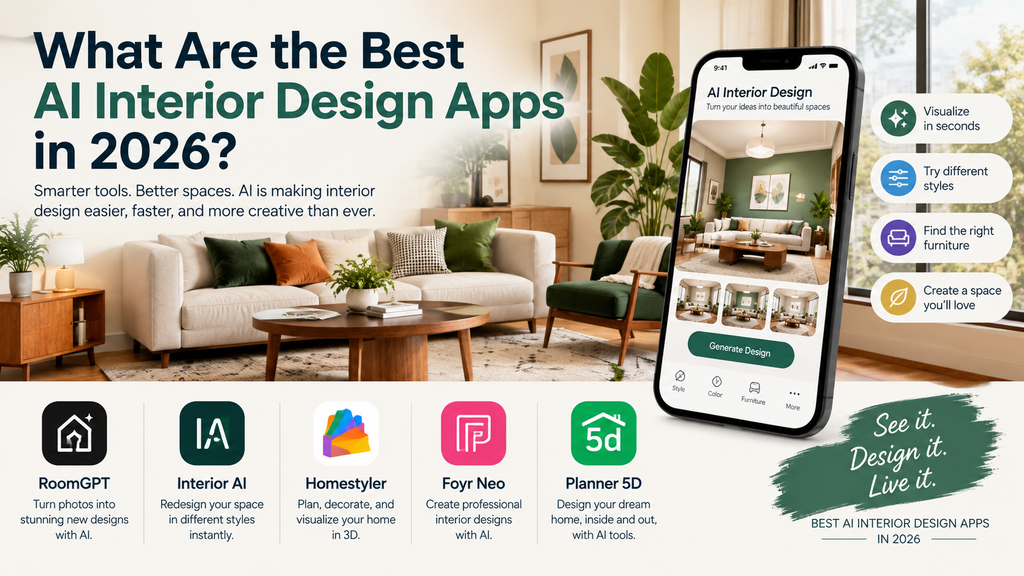
AI interior design apps have become the most crowded category in home AI, with dozens of tools competing on render quality, style variety, and pricing. In one head-to-head test covering six apps on the same room photo, Remodel AI scored 9.2 out of 10 across output quality, style range, feature set, and value, edging out competitors on overall performance. A separate, larger comparison testing sixteen apps found DecorAI ranked first overall after retesting, scoring 9.1 out of 10, with particular strength in ease of use and unlimited design generation for homeowners.
Pricing and specialization vary significantly across these tools. HomeDesignsAI stood out for offering the most complete toolkit, covering more than 80 styles across interiors, exteriors, and gardens, starting at $27 per month, while more budget-conscious users gravitated toward Remodeled AI, the cheapest tested option at $13 per month with a free tier included. For users specifically focused on real estate, Collov AI built a following among real estate professionals for its affordability and speed in virtual staging.
Which AI Design App Should You Pick Based on Your Needs?
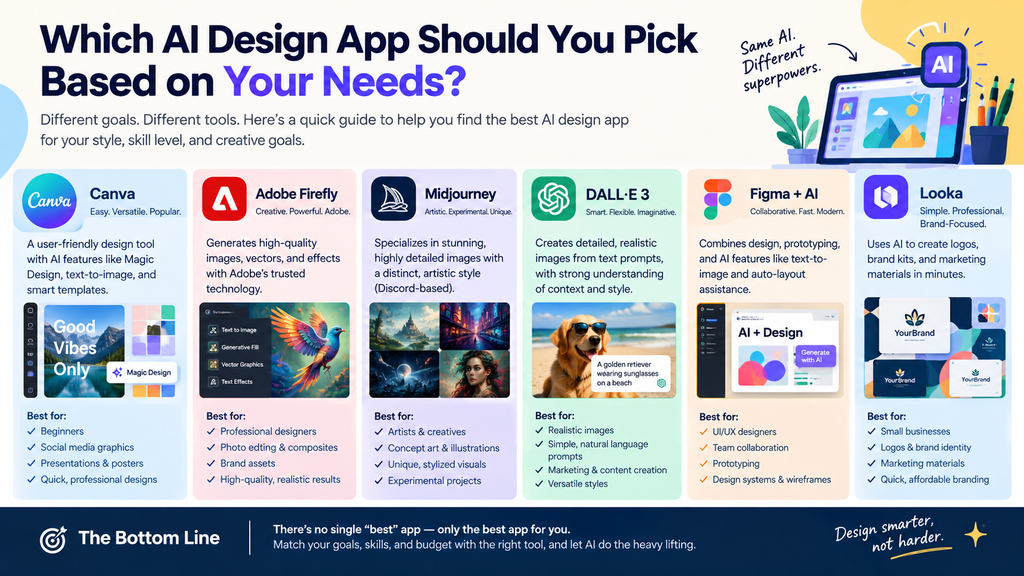
Match the app to your specific use case rather than defaulting to the highest-rated option in general testing. Homeowners wanting both interior and exterior coverage in a single free tool found Remodel AI scored 9.4 out of 10 on whole-house testing, offering three free designs covering interior and exterior redesign with no credit card required, while those specifically building detailed floor plans preferred Planner 5D, which scored 8.7 out of 10 for its multi-room 2D and 3D floor planning capabilities.
Scale and consistency are worth weighing against raw popularity. One review noted that Home AI claims more than 50 million users, making it the largest app in the category despite scoring only 6.5 out of 10 for inconsistent quality, which illustrates that app store visibility doesn’t always correlate with output quality.
What Are the Best AI Assistants for Smart Home Control?
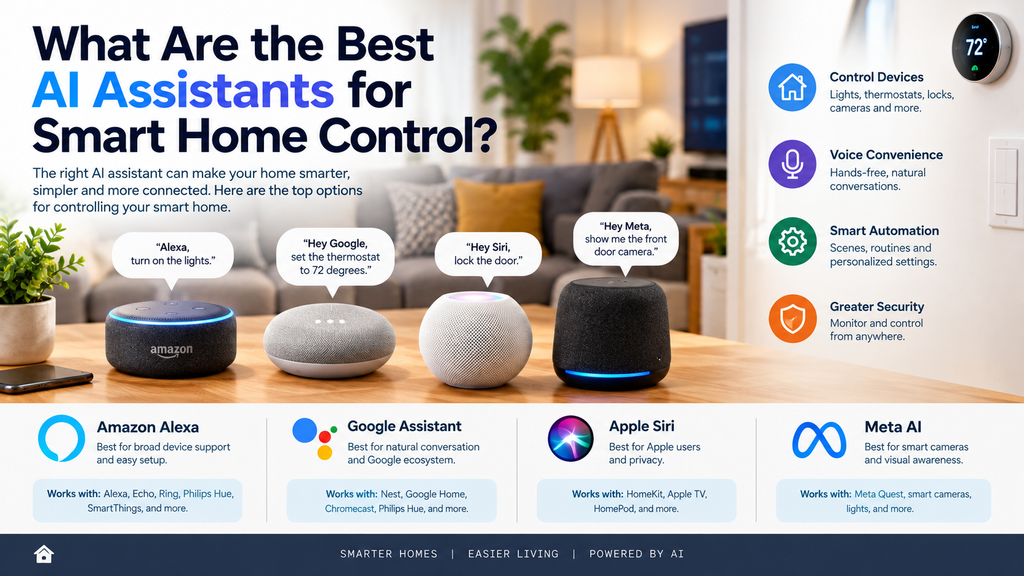
AI assistants built for voice-first smart home control differ from general-purpose chatbots in both design and testing priorities. In direct smart home device control testing, Amazon Alexa was found to be the most reliable option, with Google Home scoring 93 percent and Siri scoring 84 percent in comparison. For users who want an AI assistant that goes beyond simple commands to actually execute tasks autonomously on a connected computer, Sai by Simular was rated the top overall AI assistant, scoring 9.2 out of 10 for its ability to operate as an autonomous task-completion tool rather than just generating responses.
How Do General AI Assistants Compare for Home Use?
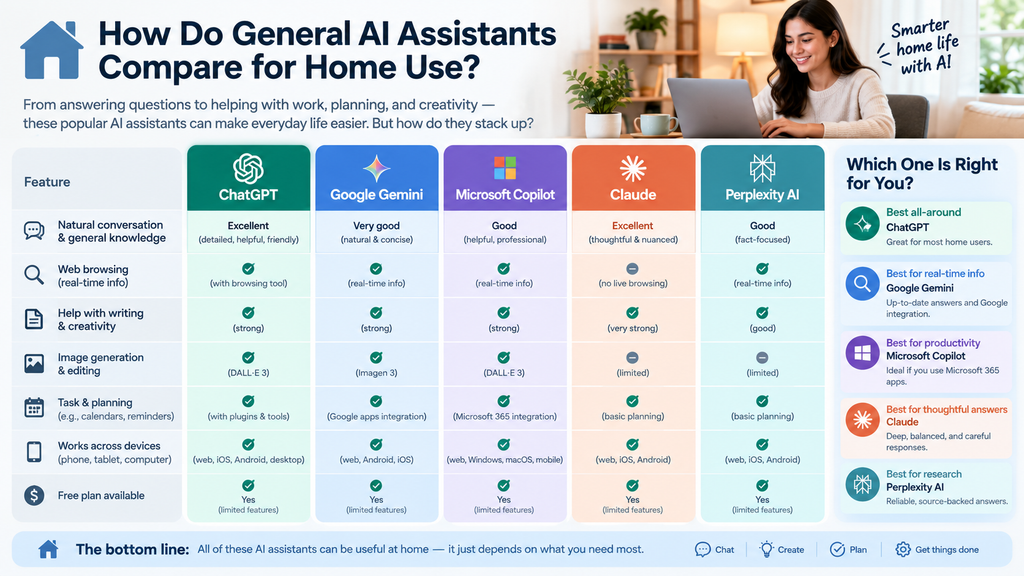
General-purpose AI assistants serve different home-related needs than dedicated smart home controllers. Google Gemini was identified as the leading choice for voice-first smart home control among broadly available assistants, while ChatGPT remained the strongest option for pure conversational AI tasks. Homeowners researching repairs, budgeting, or general planning found that ChatGPT offers broad knowledge spanning repair guidance, design input, and budgeting, making it a versatile all-purpose tool rather than a specialized one.
What Are the Best AI Household Management Apps?
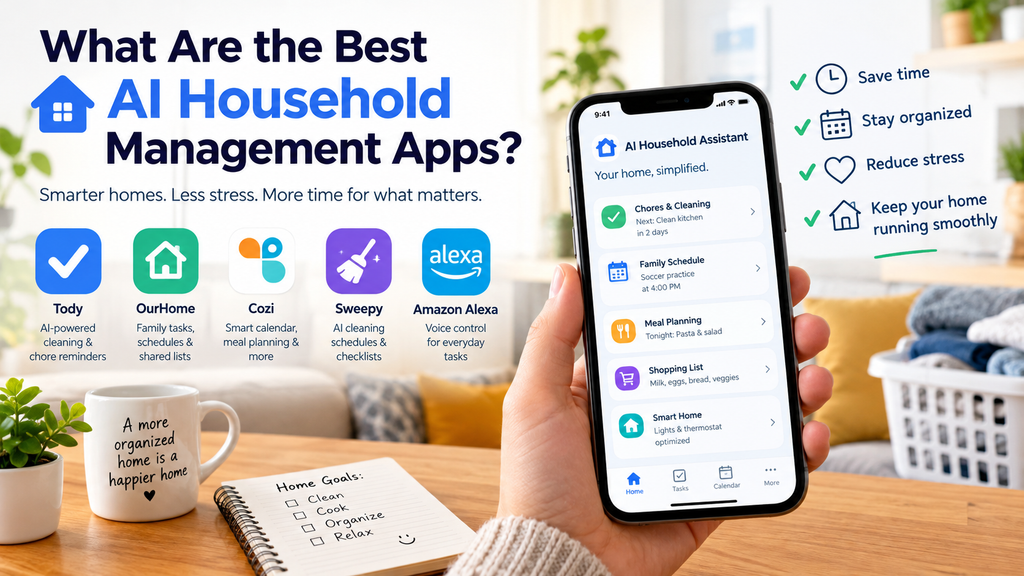
AI household manager apps handle the administrative side of running a home, including calendars, bills, contractor coordination, and family logistics. A comparison of household management tools found that Carly was identified as the top pick for households that run out of their email inbox, because it reads every mailbox and calendar in the home and then replies, books, reschedules, and follows up automatically. This level of autonomous action distinguishes it from simpler calendar or list-sharing apps.
For users who prioritize lower cost over full automation, Ohai and Cozi were identified as the cheapest way to maintain a shared family calendar and grocery list, trading some automation for affordability. Pricing across this category varies widely depending on how much of the admin work the AI actually takes on, with Carly starting from $35 per month and Duckbill ranging from $49 to $350 per month depending on how many human-assisted tasks are included.
What Are the Best AI Apps for Home Repair and Troubleshooting?
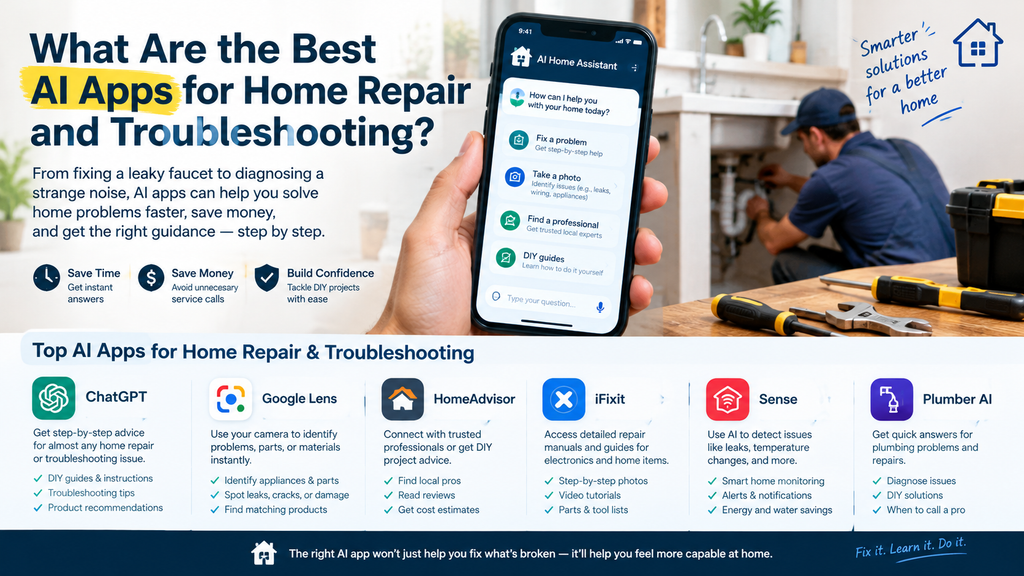
AI repair and diagnostic apps help homeowners identify problems with appliances, plumbing, or other home systems before calling a professional. Among dedicated repair tools, HomeMD stands out for homeowners who enjoy tackling repairs themselves, converting described symptoms into ranked diagnoses with clear, actionable repair steps. This symptom-to-diagnosis approach is specifically designed for DIY-oriented users rather than those planning to hire out the work.
For homeowners who prefer professional help over DIY diagnosis, task-booking platforms serve a different purpose entirely. TaskRabbit AI is built for same-day help booking, while Thumbtack AI allows homeowners to compare bids from multiple contractors, though the latter tends to move more slowly given its bid-based structure. Landlords managing rental properties have a separate set of needs better served by platforms like TurboTenant AI, which focuses on lease and maintenance workflows rather than general repair guidance.
How Should You Choose the Right Home AI App?
Choosing the right home AI app starts with identifying which specific task you’re trying to solve rather than searching for a single all-purpose “best” app. A homeowner redesigning a living room needs a visual design tool like Remodel AI or DecorAI, while someone trying to diagnose a leaking faucet needs a repair-focused tool like HomeMD, and these two needs have no meaningful overlap in app functionality. Testing free tiers before committing to a paid subscription is particularly valuable in the design category, where several apps, including Remodel AI, offer free designs with no credit card required, allowing direct comparison before spending money.
What Should You Watch Out for When Reading App Reviews?
Be cautious of “best of” lists that read more like advertisements than genuine comparisons. One tester specifically warned that picking the best AI interior design app can feel impossible because new apps launch every month, and App Store ratings are often full of paid placements that read like advertisements. Reviews that test multiple apps on the identical input, such as the same room photo or the same described home repair issue, tend to offer more reliable comparisons than lists compiled from marketing claims alone.
Common Misconceptions About Home AI Apps
A common misconception is that one home AI app can handle every category of home-related task equally well. In practice, design-focused apps, repair-diagnosis tools, smart home controllers, and household managers are built around fundamentally different data and workflows, so specialization tends to produce better results than general-purpose tools attempting to cover everything. Another misconception is that higher user counts indicate better quality; as seen with apps that have tens of millions of downloads but middling test scores, scale often reflects marketing reach and app store visibility rather than output consistency or accuracy.
Some homeowners also assume free AI design tools produce lower-quality results than paid ones. In testing, several free-tier design apps scored competitively against paid competitors, suggesting that price point alone isn’t a reliable predictor of output quality in this particular category.
Conclusion
Home AI app reviews in 2026 point to a fragmented but increasingly specialized market, with top performers like Remodel AI and DecorAI leading interior design, Alexa and Google Home leading smart device control, Carly leading household management, and HomeMD leading DIY repair diagnosis. Rather than searching for a single best overall app, homeowners get the most value by matching each specific need, whether visual, administrative, or mechanical, to the tool built specifically for it. Readers exploring this space further might also look into AI floor planning tools for new construction or AI-powered property management platforms for landlords managing multiple units.
1. What are the best home AI apps in 2026?
The best home AI apps depend on your needs. Remodel AI and DecorAI are options for interior design, Amazon Alexa and Google Home help control smart devices, Carly focuses on household management, and HomeMD supports DIY repair troubleshooting.
2. What is the best AI app for interior design?
Remodel AI and DecorAI are worth considering for visualizing room makeovers and exploring different design styles. Planner 5D is another option for users who want to create detailed floor plans and explore spaces in 2D and 3D.
3. Can AI apps redesign my home using a photo?
Yes. AI interior design apps can analyze an uploaded room photo and generate redesigned versions in different styles, colors, and layouts. Results are visual suggestions, so verify dimensions, structural feasibility, and product availability before starting renovations.
4. Which AI app is best for smart home control?
Amazon Alexa, Google Home, and Apple Siri are popular options for controlling compatible smart home devices. The best choice depends on your existing devices, preferred ecosystem, and the automations you want to create.
5. What is the best AI app for managing household tasks?
Household management tools such as Carly, Ohai, and Cozi can help organize family schedules, grocery lists, and everyday responsibilities. Their automation capabilities and pricing differ, so compare current features before choosing a subscription.
6. Can AI apps help diagnose home repairs?
Yes. AI-powered troubleshooting tools can help identify possible causes of common household problems and suggest next steps. However, their diagnoses are not guaranteed to be accurate, and electrical hazards, gas leaks, structural damage, and other dangerous issues require qualified professionals.
7. Are there free AI apps for home design?
Yes. Some AI design apps offer free trials, limited generations, or free design credits. Check usage limits, image quality, watermarks, and subscription terms before relying on a free plan for a larger project.
8. How much do home AI apps cost in 2026?
Costs vary by category. Some apps offer free basic features, while premium design tools and household management services may charge monthly or annual subscriptions. Smart home assistants may be free to use with compatible devices, although hardware and premium services can cost extra.
9. Are AI home apps accurate and reliable?
Their reliability depends on the task. Design apps can create useful visual concepts but may produce unrealistic layouts, while smart home assistants depend on device compatibility and connectivity. Repair tools can suggest possible causes but should not replace professional inspections when safety is involved.
10. How do I choose the right home AI app?
Start by identifying your main goal: redesigning a room, controlling smart devices, organizing family responsibilities, or troubleshooting repairs. Compare features, supported devices, privacy policies, user reviews, and subscription costs, then test free versions where available.
11. Can one AI app manage my entire home?
Some general-purpose AI assistants can help with planning, design ideas, shopping lists, and troubleshooting. However, dedicated tools often perform better for specialized tasks, so combining a few compatible apps may be more practical than relying on one platform.
12. Are home AI apps worth using in 2026?
Home AI apps can save time, simplify planning, and help homeowners explore design ideas or manage daily tasks. They are most useful when matched to a specific need, with important decisions about safety, construction, and spending checked independently.