

A free AI card grading app uses image recognition to estimate how a trading card would likely score if submitted to a professional grading company like PSA, BGS, or CGC, evaluating centering, corners, edges, and surface for free or with a limited number of free scans. These tools are built for collectors who want a quick, no-cost sense of a card’s condition before paying $25 to $150 or more to submit it for official grading. They are screening tools, not replacements for professional grading, and no AI grade is binding or official.Free AI Card Grading Apps: Comparison (2026)
Free AI Card Grading Apps: Comparison (2026)
A quick-reference comparison of free tiers across the major AI card grading apps.
| App | Free Tier | No Credit Card? | Subgrades | Card Types |
|---|---|---|---|---|
| TCGrader | Unlimited free grades | Yes | Limited | Pokémon, MTG, Yu-Gi-Oh, Sports, One Piece, Lorcana |
| CardMintAI | 1 free grade | Yes | All 4 (centering, corners, edges, surface) | Multi-sport + multi-TCG |
| CardGrading.app | 2–3 free scans | Yes | Yes | Pokémon-focused |
| PreGradeCards | 5 free/month + guest scans | Yes | Yes | Pokémon (specialized) + sports |
| CardSense AI | Free (iOS app) | Yes | Sub-grades + confidence | Sports + TCG |
| figoca | Fully free | Yes | Limited | Sports only |
| MasterGrade.ai | 3 free/day | Yes | Unclear | General |
These apps report self-reported accuracy claims (roughly 85–95% alignment with official PSA grades) that haven’t been independently verified — treat them as marketing figures rather than guarantees. Free tier limits and pricing change frequently in this fast-moving market.
How Does a Free AI Card Grading App Work?
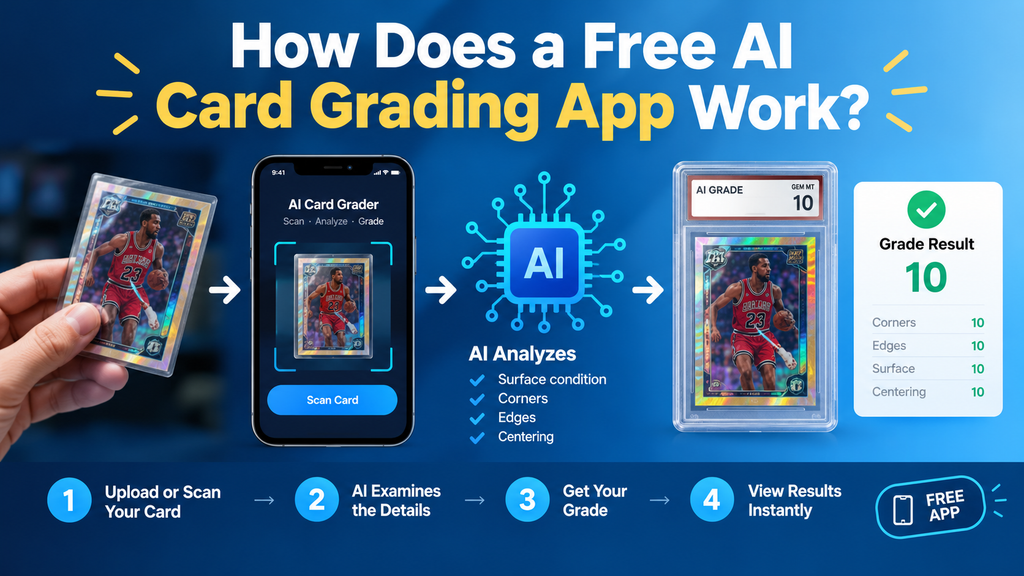
A free AI card grading app analyzes photos of a card’s front and back and scores it against the same four core criteria professional graders use. Most tools ask for clear, well-lit photos, then run them through a machine learning model trained on large sets of professionally graded cards to predict subgrades for centering, corners, edges, and surface, which combine into a single estimated numerical grade on a scale that mirrors PSA’s 1-to-10 system. Some apps add a market value estimate alongside the grade, helping collectors judge whether a card is worth the cost of an official submission at all.
The underlying technology is consistent across most of these apps: a trained image model compares the uploaded photos against patterns associated with known grade outcomes. What differs between providers is training data size, card-type coverage, and how transparent the company is about its reported accuracy against real professional grades.
What Can You Expect From the Free Tier?

Free tiers vary significantly between providers, ranging from a single free grade with no account required to several free scans per month with no credit card needed. Some tools offer one free grade to try the service, others offer a handful of free scans monthly, and a smaller number position themselves as genuinely unlimited and free for specific card categories like sports cards. Because this is a fast-moving and heavily marketed space, free tier limits and pricing change frequently, so it’s worth checking an app’s current offer directly rather than relying on older reviews.
How Accurate Are These Free Grading Predictions?
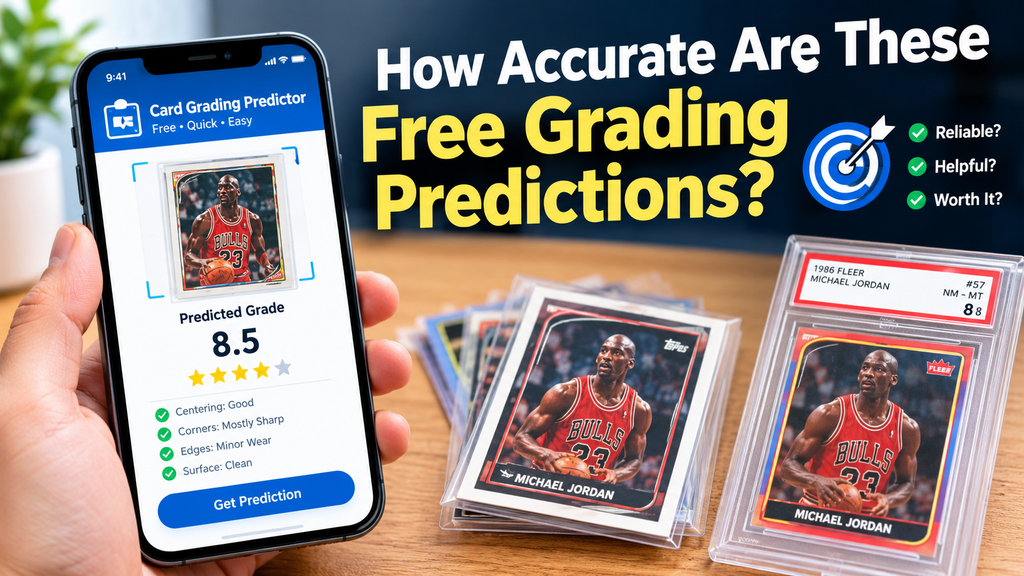
Reported accuracy for AI card grading tools generally falls in a range of roughly 85 to 95 percent alignment with official PSA grades, though these figures come directly from the companies offering the tools rather than independent, third-party audits. Because accuracy claims are self-reported marketing figures, they should be treated as a general signal rather than a guarantee, and two tools claiming similar accuracy percentages may perform differently on a specific card in hand. The most reliable way to judge an app’s usefulness is to test it on a card you’ve already had professionally graded and compare the AI’s prediction against the actual result.
What Should You Look for in a Free AI Card Grading App?
The most useful free AI card grading apps provide full subgrades for all four grading criteria rather than a single combined number with no breakdown. A tool that only outputs one overall grade gives less actionable information than one that shows centering, corners, edges, and surface separately, since a low surface subgrade might be fixable with better photos or indicate a real flaw worth knowing about before submission. It’s also worth checking whether a tool requires a credit card for its free tier, since apps that ask for payment information upfront may auto-charge once a trial period ends.
Does Card Type Coverage Matter?
Card type coverage matters significantly if you collect across multiple categories, since some apps specialize narrowly in Pokémon or sports cards while others support a broader range including Magic: The Gathering, Yu-Gi-Oh, One Piece, and Disney Lorcana. A collector focused entirely on one card type may get more specialized, accurate predictions from a tool trained specifically on that category, while a mixed collector benefits more from a broader multi-category tool even if accuracy per category is slightly less specialized.
How Should You Use AI Grading Before Submitting to PSA or CGC?
Use a free AI card grading app as a pre-screening step to decide whether a card is worth the cost and wait time of professional submission, not as a final verdict on its value. Professional grading submissions typically cost between $25 and $150 depending on turnaround speed and declared card value, so running a card through a free AI tool first can help collectors avoid spending that money on a card likely to score low. If the AI consistently flags centering or surface issues, that’s useful information for deciding whether to submit a specific card or set it aside.
It’s worth remembering that AI predictions can differ from actual grades for reasons outside the app’s control, including inconsistent lighting, photo angle, or surface glare in the uploaded images, all of which can affect how the model reads a card’s condition.
Common Misconceptions About Free AI Card Grading Apps
A common misconception is that an AI grade is equivalent to or guarantees the same result as an official PSA, BGS, or CGC grade. In reality, these are statistical predictions based on image analysis, and actual professional graders physically handle the card under controlled lighting with tools AI photo analysis can’t replicate, which means final grades can differ from AI predictions. Another misconception is that every app claiming to be “the best free AI card grading app” has been independently verified as such; this space is heavily self-marketed, with many competing tools making similar top-ranking claims about themselves, so these claims should be treated as promotional rather than neutral rankings.
Some collectors also assume a free tier offers the same depth of analysis as a paid plan. In practice, free tiers often limit the number of scans, the level of detail in subgrades, or access to market value estimates, with full-featured reports frequently reserved for paid plans.
Conclusion
A free AI card grading app gives collectors a fast, no-cost way to estimate how a card might grade before committing to a paid professional submission, using image analysis to score centering, corners, edges, and surface. Because this market includes many competing tools with self-reported accuracy claims, the best approach is to test a free tier against a card you already know the official grade for, rather than relying solely on any single site’s “best app” ranking. Readers exploring this topic further might also look into how professional grading companies like PSA and CGC determine final grades, or how to photograph cards properly to get the most accurate AI predictions.